
In Brief
- Mastermind detained: The individual who allegedly ordered the 2024 assassination of State Prosecutor Randall Hector has been held at Teteron Barracks since last year, cut off from his criminal network.
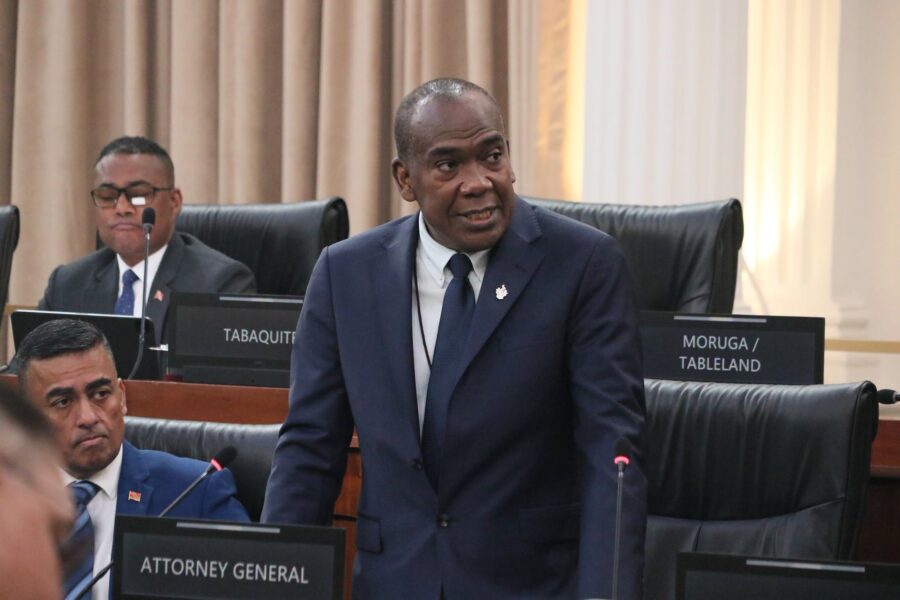
- New legislation: Attorney General John Jeremie, SC, revealed this while piloting the Special Operations Bill 2026 in the House of Representatives on Friday.
- Enhanced powers: The Bill establishes seven policing districts and grants security forces enhanced search, seizure, and curfew powers to combat gang violence without requiring a special majority to pass.
By Prior Beharry
A person who ordered the hit on State prosecutor Randall Hector has been detained at the Teteron Barracks in Chaguaramas since last year and cut off from his network.
This revelation was made by Attorney General John Jeremie, SC, as he piloted the Special Operations Bill 2026 in the House of Representatives on Friday.
Hector, a 43-year-old legal officer and prosecutor for the Strategic Services Agency (SSA), was killed on Old Year’s Night 2024.
The AG said he was gunned down “with clinical precision,” outside a church in Cascade after delivering a sermon entitled “The Goodness of God.”

Jeremie said, “A state prosecutor in gang-related killings in the employ of my office was slaughtered on Old Year’s Night in Sydenham Avenue, Cascade.”
He said Hector was executed with “clinical precision and obvious meticulous planning.”
Jeremie said, “A black SUV and a Nissan B15 ambushed his family a mere 10 feet from the family’s vehicle. The gang members, the murderers, jumped out and shot him in the chest seven times… That was the response of the gangs then in 2024.”
“Their immediate answer to the declaration of their State of Emergency was to do precisely what they themselves said they were attempting to avoid, by the declaration.”
“Madam Deputy Speaker, that one incident, one example, it was one example of the terror that we escaped as a country, a glimpse of what might have been today had they not been removed from office in 2025.”
Jeremie added, “This morning I can report to the House and to the country that the individual who is alleged to have commandeered that hit has been a resident of Teteron since last year, cut off from communication with his network and unable to exhibit the level of contempt for the rest of us that kept those opposite timed, silent…”
He said the bill was designed to give police and the military “enhanced,” but constitutionally sound powers to combat gang violence, while insisting it does not rise to the level of a state of emergency.

Jeremie said under the previous administration, the murder toll was 580 in 2023 and 626 in 2024.
Citing a CNN report from 2024, Jeremie noted Trinidad and Tobago’s murder rate was roughly twice that of Venezuela – a country of 28 million grappling with prolonged political and economic crisis – and compared local violence unfavourably to nations recovering from actual armed conflict.
Bill’s framework: Seven policing districts
Jeremie outlined the Bill’s structure in detail:
- Part I (Clauses 1–3): Preliminary matters, including definitions of “closed area,” “cordon district,” and “weapon,” (the latter incorporating the Anti-Terrorism Act’s definition covering firearms and explosives).
- Part II (Clause 4): Establishes seven policing districts — six in Trinidad, aligned with municipal corporation boundaries, and Tobago as a single district.
- Part III (Clauses 5–10): Governs administration of special operations, including appointment of a senior police officer (superintendent or higher) to head operations in each district, and a military officer (major or higher) to lead military assistance — both appointments subject to Prime Ministerial veto after mandatory consultation with named officials. Clause 8 establishes a reporting chain culminating in an annual report to Parliament by the Prime Minister. Clause 10 grants operational personnel full constabulary powers under the Police Service Act.
- Part IV (Clauses 11–23): The Bill’s operative core. Clause 11 sets out criteria for declaring a “closed area,” — including escalating violent crime, illegal firearms prevalence, or gang intimidation of communities — subject to negative resolution of the House and a mandatory presidential statement of grounds within seven days. Clauses 12–14 provide for permit-controlled cordons and curfews.
- Clause 15 grants warrantless search powers based on reasonable suspicion and allows seizure of vehicles, articles, or documents deemed useful to preventing disorder or of investigative value.
- Clause 16 addresses seized property handling.
- Clause 17 provides judicial oversight of arrests.
- Clause 18 criminalises obstruction of officers.
- Clause 19 mandates escalation procedures if detention exceeds 36 hours without a remand order.
- Clause 20 sets welfare standards for detainees, including mandatory medical care regardless of complaint.
- Clause 21 mandates body-worn cameras “as far as possible,” and subject to available resources; and a further clause requires registration of all weapons and ballistic signatures with the Forensic Science Centre before operations begin.
- Part V (Clauses 24–26): Miscellaneous provisions, including permit applications, regulation-making powers, and — notably — a two-year sunset clause.
No special majority required, AG argues
Jeremie said the bill requires only a simple majority to pass — unlike the earlier Zones of Special Operations Bill.
He acknowledged the legislation “might interfere,” with rights under Sections 4(a), 4(c), and 4(g) of the Constitution — liberty and property, private and family life, and freedom of movement, respectively — but argued any infringement is “reasonable and proportionate,” invoking the Privy Council rulings in Suratt and Suraj.
Jeremie cited paragraph 58 of Suratt, where Baroness Hale held that not every rights-infringing law requires a special majority provided it pursues a legitimate aim and satisfies a proportionality test — though he conceded the threshold for justification is higher when legislation is passed by simple majority rather than special majority.

He pointed to built-in safeguards he said support proportionality: mandatory training requirements, the reporting and accountability framework, standard operating protocols, parliamentary oversight of closed-area declarations, the permit system tempering cordons and curfews, search-and-seizure limitations, judicial scrutiny of detentions, and body-worn camera requirements.
Jeremie noted Prime Minister Kamla Persad-Bissessar’s remarks from Wednesday’s sitting, saying the Bill was vindicating “the rights of the people who have borne the burden of violent crime: grieving parents, families terrorised in their homes, businesses facing extortion and young persons threatened by gangs.”
Quoting an unnamed political leader from six decades ago, Jeremie told the House: “No problem of human destiny is beyond human beings… We will build a nation of peace where the weak are safe and the strong are just.”