
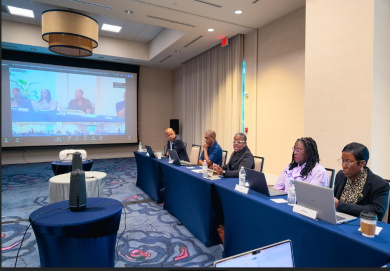
Caption: CARICOM negotiators will head to COP31 carrying the lived realities of the region’s people
In Brief
- Strategic Alignment: Caribbean Community (CARICOM) stakeholders concluded a three-day meeting in Miami to coordinate regional priorities for the upcoming COP31 climate summit in Türkiye.
- Urgent Threat: Leaders highlighted the UNEP’s latest report, warning that global warming is on track to exceed the critical 1.5°C threshold, which poses an existential threat to the region.
- Unified Voice: Officials emphasised that the Caribbean’s strength lies in its unified stance, demanding continued global commitment to science-based climate action to secure the region’s future.
MIAMI (CMC) – Caribbean Community stakeholders ended a three-day meeting here on Wednesday, coordinating the region’s negotiating priorities ahead of the 31st Session of the Conference of the Parties (COP31) to the United Nations Framework Convention on Climate Change (UNFCCC), which takes place in Türkiye next month.
The Second Meeting of CARICOM Negotiators and Ministers Preparatory to COP31 was convened by the Belize-based Caribbean Community Climate Change Centre (CCCCC), following the first meeting in Guyana in March this year in preparation for the 9–20 November COP meeting.

“CARICOM negotiators will head to COP31 carrying the lived realities of the region’s people, whose vulnerability to climate change is underscored by the latest scientific findings,” according to a statement issued at the end of the meeting.
The statement highlighted that the United Nations Environment Programme’s Emissions Gap Report 2025: Off Target warns that global warming will exceed 1.5°C, at least temporarily, and that even full implementation of current national climate pledges would put the world on course for 2.3–2.5°C of warming this century.
CARICOM Assistant Secretary General, Dr Wendell Samuel, emphasised the urgency of maintaining ambitious global climate action.
“For CARICOM, climate change remains the defining sustainable development challenge of our generation. Our people do not experience climate negotiations; they experience climate impacts. They experience stronger storms, damaged infrastructure, and disrupted livelihoods.”

“We must continue to defend the 1.5-degree temperature goal at a time when some may be tempted to lower ambition in response to domestic economic and geopolitical pressures. CARICOM must continue to advocate for science-based action. For our region, 1.5 is the line between manageable risk and irreversible loss and damage,” he added.
The statement noted that for the Caribbean, every fraction of a degree of overshoot increases the risk of extreme weather events and accelerating environmental and ecological degradation, with far-reaching consequences for public health, livelihoods, economic stability, and security.
It added that these are not distant projections and that for the region’s small island and low-lying coastal developing states, these existential threats are already unfolding.
“The strength of the Caribbean and our negotiators has never been in the size of our emissions; it has always been in the clarity of our cause and the discipline of our common position,” said CCCCC’s executive director, Dr Colin Young.
“We have proof of what a united region and a united AOSIS can deliver in these negotiations. The best outcomes will not be handed to us. We have to demand it, defend it with courage and unity.”
The statement concluded that through strengthened coordination, CARICOM’s delegation concretised the regional position ahead of COP31, “and will carry a shared understanding of the region’s priorities, ensuring Caribbean voices are well represented, unified and heard.”