
In Brief
- Thousands of mourners lined the streets of Port of Spain on Friday to bid a final farewell to Dr Slinger Francisco, internationally revered as ‘The Mighty Sparrow’.
- Prime Minister Kamla Persad-Bissessar announced that the Grand Stand at the Queen’s Park Savannah will be renamed in the iconic calypsonian’s honour.
- The State-Assisted Funeral featured a procession through the capital, culminating in a massive cultural tribute at the National Academy for the Performing Arts (NAPA).
- Regional leaders, including Barbados Prime Minister Mia Mottley, and citizens alike paid tribute to the 91-year-old cultural icon, who passed away in New York on September 27.
By Prior Beharry
As the body of “The Mighty Sparrow,” passed in front of the Royal Gaol (the State Prison) on Frederick Street, a music truck blared the voice of Slinger Francisco singing, “Praise the Lord in Jesus name.”
Coming to mind were lyrics from his song Drunk and Disorderly: “Don’t worry to beg the jury / Save the lawyer fee / And if you have any mail / I live in the Royal Jail.”
The sheer versatility of Sparrow’s repertoire could be heard from the Brian Lara Promenade in Port of Spain from 10 am on Friday, where his funeral procession started. The music truck blared his hits, ranging from “Jean and Dinah,” “Lies,” and “Age is Just a Number,” to his Christmas medleys and gospel music.

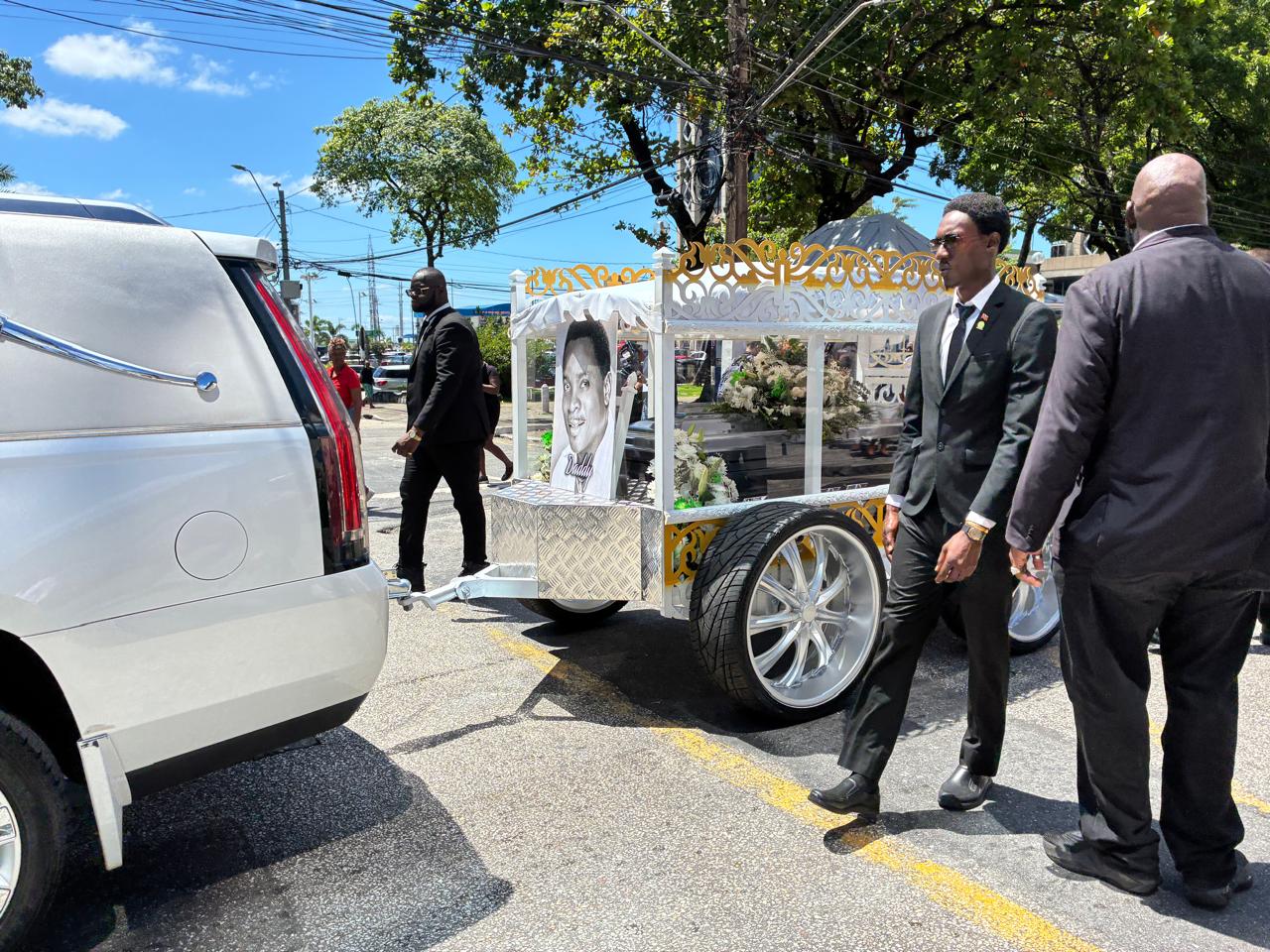
Schoolchildren, the young, and the old all paid tribute. Hundreds lined the promenade and Frederick Street with phones in hand to capture history. The hearse towed a trailer carrying his casket as onlookers took pictures and police stood by to control the enthusiastic mourners dancing to his music.
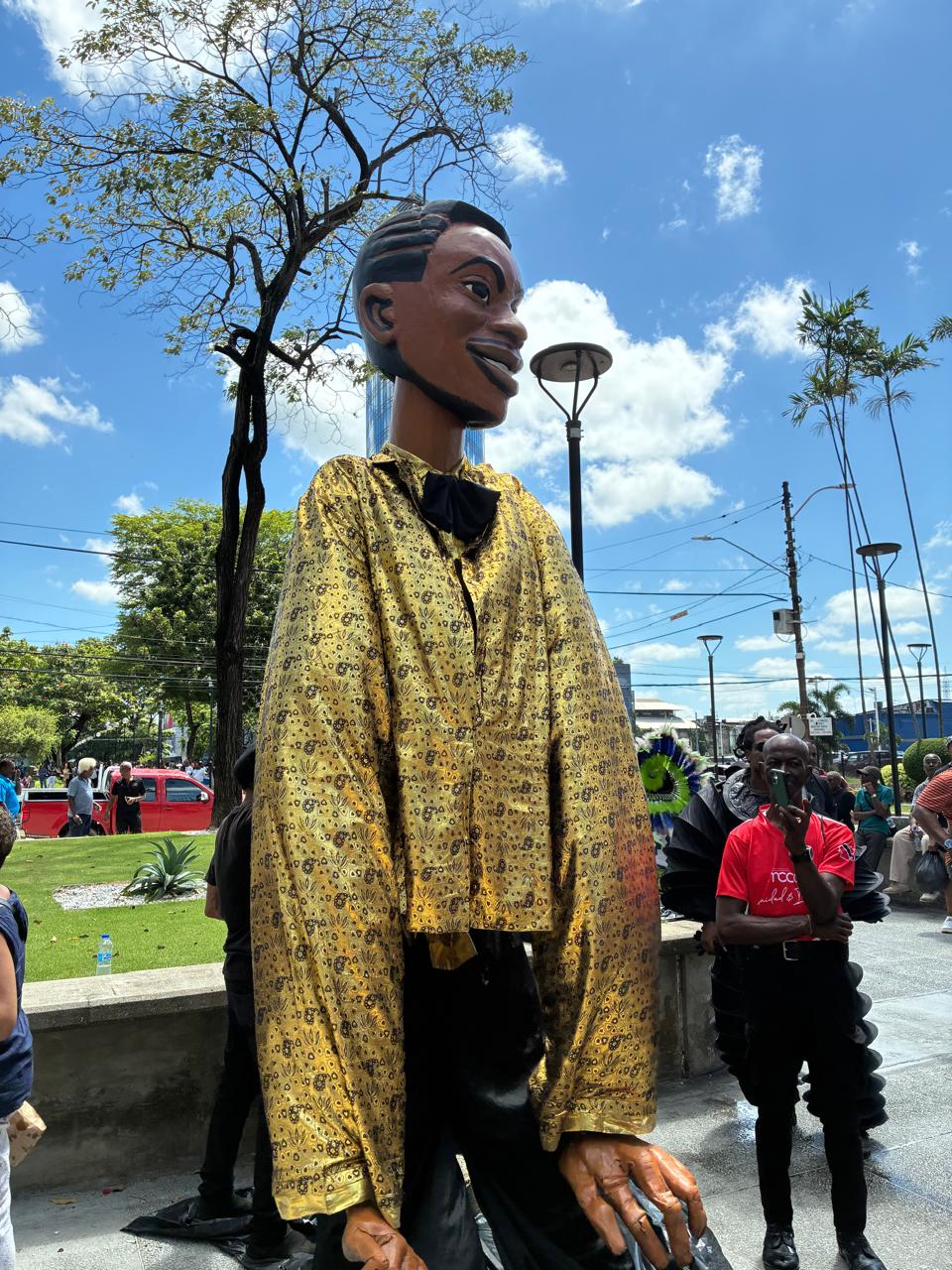
The country where calypso was invented paid tribute in an emotional farewell to Francisco, known globally as “The Mighty Sparrow,” and widely revered as the “Calypso King of the World,” at a ceremony at the National Academy for the Performing Arts (NAPA), where the procession ended at the top of Frederick Street.
There, Prime Minister Kamla Persad-Bissessar announced that the Grand Stand at the Queen’s Park Savannah will bear the name of Slinger Francisco, aka “The Mighty Sparrow.”
The iconic singer passed away peacefully on September 27, 2026, in New York, surrounded by his family following a brief illness. He was 91.
The Government of Trinidad and Tobago, in collaboration with the Francisco family, declared a period of national remembrance culminating in Friday’s State-Assisted Funeral and Celebration of Life.
Sixty-five-year-old Raymond said he was in Port of Spain to pay his respects to Sparrow, who he said will never be replaced.
Kyla John, a 20-year-old accountant, said, “I am here to enjoy the culture and to see how it was to the last generation; they are representing a lot of good energy and positivity.”
Nareen Ragbir, a 22-year-old clerk, said, “I’m here to celebrate the life of a great legend.”
Sparrow’s daughter, Michelle Francisco, said her father was not a typical dad who helped with homework or “fired up the grill,” because “we had to share him with the world.”
Trinidad and Tobago Minister of Culture Michelle Benjamin said, “How do you say farewell to a man whose music has become permanent? And when I say permanent, it is part of who we are as a people.”
“How do you say farewell to a legend whose voice has lived in our homes? Our Carnival celebrations are part of our laughter, our struggles, and our memories,” she added. “How do we measure the life of a man who gave the nation not just songs, but the soundtrack to our history?”
Barbados Prime Minister Mia Mottley said Sparrow used calypso “as a means by which we could tell the stories of our lives, inspire our people to greater action, laugh, and treat it like a pressure cooker to make sure that we don’t explode out of madness. But we come to understand that life must be balanced, and in balance we think, we reflect, but equally we laugh, we lime (hang out), and we dance.”
Global Icon of Social Commentary and Wit
Born in Grand Roy, Grenada, in 1935, Francisco moved to Trinidad as an infant, where he grew up to fundamentally reshape the landscape of Caribbean music.
He burst onto the international stage in 1956 with his breakout hit “Jean and Dinah,” winning his first national Calypso King title.
Over an extraordinary career featuring more than 70 albums and 500 composed songs, “The Birdie,”—as he was affectionately nicknamed—captured the global imagination with a trademark mix of biting political satire, social commentary, profound humour, and suggestive double entendres. His work earned him top national honours, including the Order of the Republic of Trinidad and Tobago, the country’s highest award.
Among the many tributes was one from former President of Trinidad and Tobago Anthony Carmona,who said that Sparrow was considered “the philosopher king of calypso,” and maintained that the Nobel Committee in Sweden fell short by not awarding this great son of the Global South the Nobel Prize in Literature, having previously recognised Bob Dylan for his lyrical and artistic contributions.
“Sparrow was beyond an entertainer; he was a national institution, a cultural ambassador, and one of the Caribbean’s most influential voices whose music shaped generations. He mixed social commentary with humour, and many of his songs were considered taboo at the time, but he was a great entertainer,” Historian Dr Jerome Teelucksingh of the University of the West Indies said.
Final repatriation and mourning
Following an emotional homegoing memorial service held by the Caribbean diaspora in New York, the calypsonian’s body was officially repatriated to Trinidad and Tobago on October 6. His casket arrived at Piarco International Airport via a Caribbean Airlines flight and was received by his son, Cyril Sancho Francisco, and Minister of Culture and Community Development Michelle Benjamin.
A legendary state farewell
Trinidad and Tobago’s government promised a grand, dignified send-off. The funeral events on Friday featured a massive street procession charting through the capital city of Port of Spain. Moving from Independence Square along Frederick Street, the procession transitioned through three distinct phases: “The National Farewell,” “The People’s and Cultural Farewell,” and “The Ceremonial Farewell,”.
The Ministry of Culture has also dedicated the entire month of October—traditionally celebrated as Calypso History Month—entirely to the memory and enduring global impact of “The Mighty Sparrow.”
Some of Sparrow’s Most Famous Calypsoes:
Jean and Dinah (1956): “Jean and Dinah,” was Sparrow’s breakout masterpiece, winning him his very first Calypso King and Road March titles by capturing a specific moment in Trinidad’s history—the departure of the US military from their bases after World War II. During the war, local sex workers preferred the high-spending American soldiers over local men, but with the Americans gone, Sparrow mocks the prostitutes (“Jean and Dinah, Rosita and Clementina,”), declaring that prices have dropped and local men are back in charge. The track perfectly captured the shifting social dynamics of the era and remains one of the most famous calypsos in history.
Federation (1962): Written after the collapse of the West Indies Federation, “Federation,” stands as one of Sparrow’s most famous political commentary tracks. The Federation was an attempt to unite 10 Caribbean islands into a single independent state, but after Jamaica voted to leave—prompting Trinidad’s Prime Minister, Dr Eric Williams, to famously declare that “1 from 10 leaves 0,”—Sparrow used the song to express bitter disappointment and anger. He blasted Jamaica and the other islands for abandoning the union, singing, “Federation boil down to nothing / It’s a national crying shame,” perfectly capturing the region’s frustration.
Education (1967): A classic example of Sparrow using his platform for social advancement and nation-building, “Education,” was written during a period when a newly independent Trinidad and Tobago was expanding its free secondary public education system under Eric Williams. Sparrow used the track to urge the youth to stay in school and ignore the allure of quick money or street life. His poignant lyrics, “Children go to school and learn well / Otherwise later on in life you will catch real hell,” resonated deeply, becoming an unofficial anthem for Caribbean parents and schools for generations.
Congo Man (1965): Set against the backdrop of the geopolitical turmoil and civil unrest in the Congo during the 1960s, “Congo Man,” remains one of Sparrow’s most controversial and provocative songs, utilising heavy double entendre and dark humour. The lyrics describe a tribal African man catching and preparing to eat two white female travellers, themes that were heavily criticised and led to the song being banned from the radio by some authorities for its cannibalistic and sexually charged nature. However, despite—or perhaps because of—the ban, it became a massive party hit due to its incredibly infectious rhythm.
Philip My Dear (1982): Inspired by a real-world international security scandal, “Philip My Dear,” is a brilliant piece of political satire based on the July 1982 incident where an intruder named Michael Fagan scaled the walls of Buckingham Palace and entered Queen Elizabeth II’s bedroom. Sparrow framed the song as a hilarious, fictional monologue from the Queen to her husband, Prince Philip, as she tries to explain why a strange man was sitting on her bed talking to her while Philip slept through the entire ordeal. The track became a massive global hit that perfectly showcased Sparrow’s sharp wit and storytelling prowess.