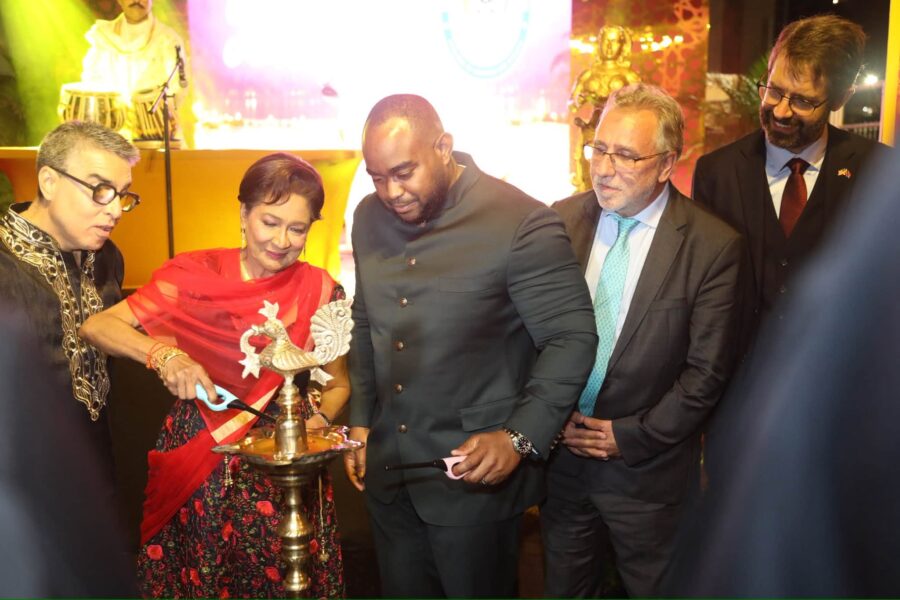
Caption: Prime Minister Kamla Persad-Bissessar lights a deeya as Minister of Foreign and CARICOM Affairs Sean Sobers, Venezuela Ambassadro Álvaro Enrique Sánchez Cordero, left, French Ambassador, second right Guillaume Pierre and US Embassy Chargé d’Affaires Philip Kern, right look on
In Brief
- The Stance: Prime Minister Kamla Persad-Bissessar says she stands firmly by Trinidad and Tobago’s decision to vote against lifting the US embargo on Cuba, stating that the Cuban people deserve democracy rather than a ‘military dictatorship.’
- Historic Policy Shift: On October 28, T&T broke a 32-year diplomatic tradition at the UN General Assembly by voting ‘Against’ the annual resolution to end the US embargo—having voted in favor of Cuba every year from 1993 to 2025.
- CARICOM Split: The vote placed T&T alongside the United States and at odds with its regional neighbours; seven CARICOM nations voted in favor of Cuba, while Jamaica, Guyana, and Haiti abstained.
- Waning Global Support: Although the UN resolution passed for the 34th consecutive year (130 in favor, 17 against, 25 abstentions), an aggressive US lobbying campaign resulted in the weakest global backing for Cuba in two decades.
By Prior Beharry
Prime Minister Kamla Persad-Bissessar has defended her government’s decision to break with decades of foreign policy at the United Nations, declaring that she wants democracy for the people of Cuba rather than the continuation of a “military dictatorship.”
Speaking at the Ministry of Foreign and CARICOM Affairs Divali Celebrations for Diplomats on Thursday, Persad-Bissessar said she stood firmly by Trinidad and Tobago’s recent vote at the UN General Assembly (UNGA) to keep the US embargo against Cuba.

“I stand for freedom. I stand for democracy. And in Cuba, the people deserve a democratic government,” the Prime Minister told the gathering of diplomats.
She said, “They are suffering. We feel the human suffering of the Cuban people. But we cannot stand by and do nothing or say nothing to support a military dictatorship in Cuba.”
Drawing parallels between the festival of lights and her administration’s foreign policy, Persad-Bissessar argued that Trinidad and Tobago could not enjoy its own democratic freedoms while ignoring the plight of its neighbors.
She said, “Just as the light of Divali guides us towards a brighter future, our commitment to freedom and democratic values must guide us to advocate for the right of every individual, at home and abroad, to live in dignity, in hope and freedom.”
Persad-Bissessar said, “We cannot want to live in light at home and remain silent when others live in the shadows of oppression and exploitation. As I’ve said before, we cannot demand democracy and free and fair elections for ourselves and remain silent when those freedoms are denied for neighboring citizens in neighboring countries.”
The Prime Minister also pushed back against critics who condemned the government for abandoning Trinidad and Tobago’s traditional diplomatic stance.
“We cannot stand up and talk here and say leave Cuba alone. Twenty-nine plus years, it’s all been the same. It has not changed,” Persad-Bissessar said.
She said, “They are our neighbours, they are our friends. We cannot, as well, continue to do the same as has been done before. Some of our critics are saying, ‘Oh, Trinidad always had, always had.’ So when will it ever end? And it must end one day. They should have a democracy and the freedoms that we have and enjoy here in Trinidad and Tobago.”
In an earlier statement, the Prime Minister noted that while the country supports ordinary Cuban citizens, its new posture targets Cuba’s political leadership, whom she accused of living in luxury while the general population suffers.
A Historic Shift at the UN
Persad-Bissessar’s remarks follow a major diplomatic shift on October 28, 2026, when the UN General Assembly voted for the 34th consecutive year to adopt a non-binding resolution calling for an end to the decades-long US economic, commercial, and financial embargo against Cuba.
In a departure from over three decades of foreign policy, Trinidad and Tobago voted “Against” the resolution, standing alongside the United States. Except for an initial abstention when the resolution was first introduced in 1992, Trinidad and Tobago had voted in favor of lifting the embargo every single year from 1993 through 2025.
The move placed Port of Spain sharply at odds with its Caribbean Community (CARICOM) partners. While seven regional nations maintained their support for Cuba, others—including Jamaica, Guyana, and Haiti—chose to abstain.
Weakest Support for Cuba in Two Decades
While the UN resolution was ultimately adopted, an aggressive lobbying and pressure campaign led by US Ambassador to the UN Mike Waltz resulted in a sharp drop in global backing for Havana, marking the resolution’s weakest support in 20 years.
How they voted:
- In Favor: 130 countries (down sharply from 165 in 2025)
- Against: 17 countries (up from 7 in 2025)
- Abstentions: 25 countries (up from 12 in 2025)
- Alongside Trinidad and Tobago and the United States, the 17 opposing votes included Israel, Argentina, Paraguay, Hungary, North Macedonia, and Ukraine, among several other nations that shifted their positions from the previous year.
The 2026 vote took place against the backdrop of a severe energy crisis and worsening humanitarian strain across Cuba, exacerbated by intensified US pressure. Following political transitions in Venezuela, Washington has sought to block oil shipments to the island by enacting secondary sanctions and threatening 30 percent tariffs against third-party nations that send fuel to Cuba.
Addressing the UN, Cuban Foreign Minister Bruno Rodríguez Parrilla condemned the embargo as “collective punishment,” stating that the sanctions had cost Cuba more than $8 billion in a single year.