
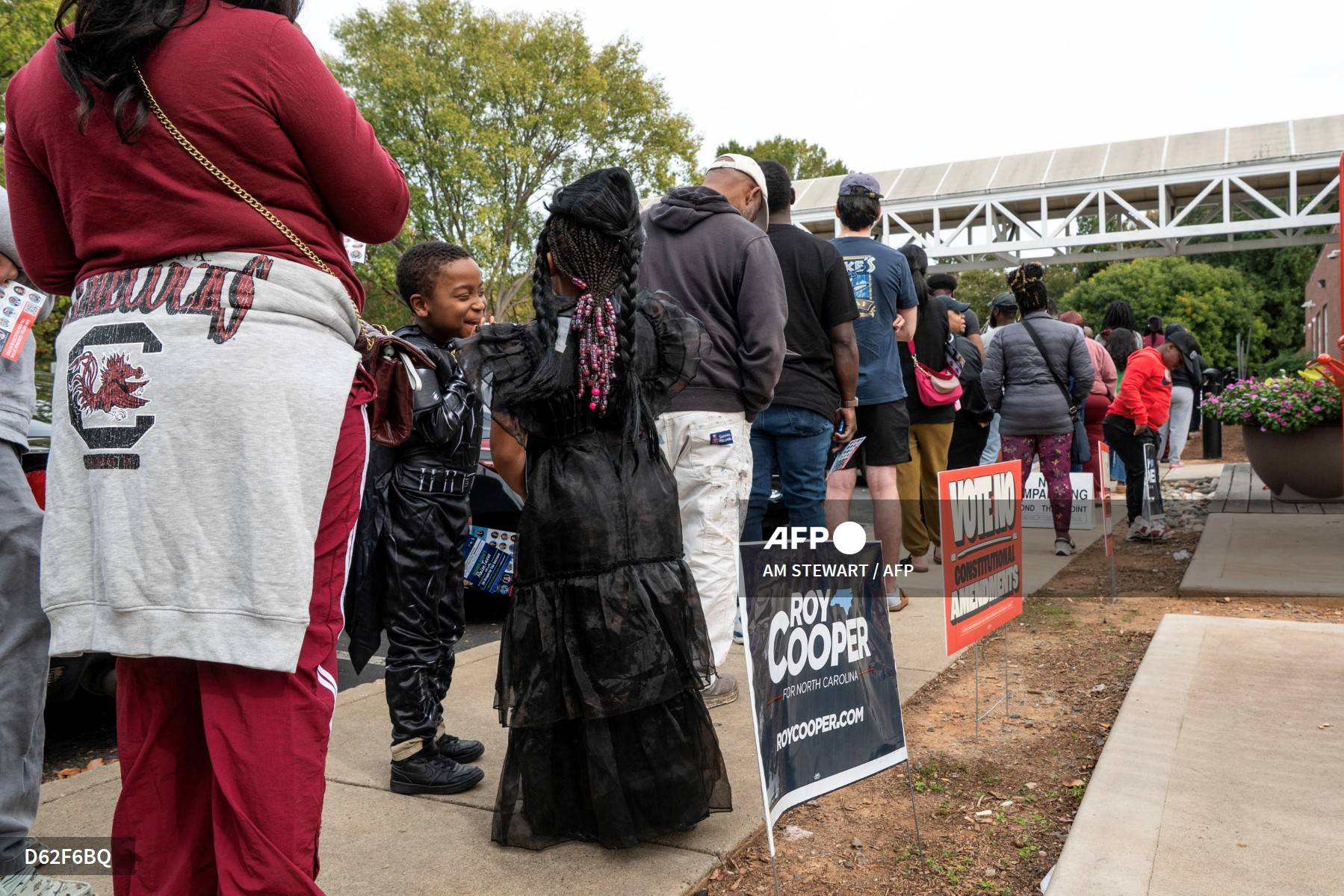
Caption: Voters arrive to cast their ballots on the final day of early voting ahead of the November 3 midterm elections in Charlotte, North Carolina, on October 31, 2026
In Brief
- US Midterms & Energy Impact: With Americans voting on 3 November, a potential split Congress could increase oversight on Caribbean and Venezuelan policies, while post-election geopolitical escalation in Iran and Russia threatens to push Brent crude—already topping US$117—even higher.
- Global Market Divergence: Wall Street slid on disappointing Big Tech earnings and a major crypto hack, whereas European markets rallied on better-than-expected third-quarter GDP growth and Asian indices posted mixed results.
- Local Equities Rally: Trinidad and Tobago’s stock market traded firmly with trading volume more than doubling (+111.27%), led by strong price advances from JMMB Group, Trinidad Cement, and Prestige Holdings.
- Sovereign & Corporate Bonds: T&T’s USD sovereign bonds gained ground as US Treasury yields eased, while TSTT launched a US$500 million, 10-year senior secured bond offering at a 9.75% coupon to refinance its 2029 debt.

Americans vote on 3 November for all 435 House seats and 35 Senate seats. Non-partisan forecasters favour Democrats in the House, while Senate control remains closely contested. A split Congress would shift President Trump’s final two years towards negotiation and executive action rather than new legislation.
Trinidad and Tobago (T&T) would be affected through several channels, starting with energy policy. US Treasury licences for T&T’s development of Venezuela’s Dragon gas field remain an executive function, outside Congress’s direct control. A Democratic House could, however, intensify oversight of Venezuela policy and the US military presence in the Caribbean, where T&T has worked closely with Washington.
Secondly, Bloomberg reported this week that Brent topped US$117 on signs that the US may resume strikes on Iran after the elections, while Ukraine has reportedly paused attacks on Russian refineries until the vote is over. Any post-election escalation would lift T&T’s energy revenue, but also increase import costs and global inflation.
Wall Street ended the week lower as third-quarter earnings disappointed. Amazon reported soaring spending and its slowest core e-commerce growth in three years, while Intel shares fell sharply after weak fourth-quarter guidance. Alphabet dropped 12.61% over five days, Meta 4.30%, and Nvidia 3.00%, while Caterpillar (-9.35%) and Boeing (-8.92%) also fell. Energy markets performed much better; ExxonMobil (+2.21%) and Chevron beat profit forecasts on strong refining margins. Meanwhile, a US$6.3 billion hack at Binance added to risk aversion. Treasuries rallied, with the 10-year yield easing to 4.93% and the 30-year to 5.31%.

In the United Kingdom and Europe, a growth surprise lifted shares. The STOXX Europe 600 rose 1.73%, with the DAX up 2.53%, the CAC 40 up 2.40%, and Italy’s FTSE MIB up 1.94%. Euro-area GDP grew 0.4% in the third quarter—twice the expected pace—despite a small contraction in France. Siemens Energy gained 6.94% and TotalEnergies 2.37%, while Banco Santander fell 12.09%. The FTSE 100 added a modest 0.37%, held back as BP slipped 1.81% despite reporting its highest profit in 18 years.
In Asia, performance was mixed. Japan’s Nikkei 225 rose 0.95% and Hong Kong’s Hang Seng gained 0.87%. Australia’s ASX 200 gained 1.28%, helped by BHP (+4.56%). Mainland China lagged, with the Shanghai Composite down 2.48%.
Trinidad and Tobago equities traded firmly as activity picked up. The Composite Index rose 0.56% to 999.19 (+5.57% year-to-date), the All T&T Index gained 0.63% to 1,401.68, and the Cross-Listed Index added 0.34%. Market breadth was positive, with 12 stocks advancing and five declining. Trading volume more than doubled, up 111.27% to 1.38 million shares, and value rose 9.55% to TT$9.55 million. Guardian Media led volume with 33.31% of shares traded, followed by Massy and NGL.
JMMB Group was the top advancer, up 18.67% to TT$0.89 ahead of an interim dividend decision. Trinidad Cement rose 12.99% to a 52-week high of TT$2.00, and Prestige Holdings gained 9.09% to TT$12.00. Domestic banking system excess liquidity fell by about TT$452 million to TT$3.69 billion.
In the regional bond market, Trinidad and Tobago’s USD bonds gained ground as US Treasury yields eased, though longer maturities still trade below par. The 2038 bond, which was bid at 92.60 on 9 October, has gained more than a point as the 10-year Treasury yield fell from 5.24% to about 4.93%. Its yield of just under 7.0% is now in line with the Dominican Republic’s BB-rated 2038 bond (6.75%), but still above Jamaica’s 2037 bond (6.31%).
Telecommunications Services of Trinidad and Tobago (TSTT) launched new 10-year global bonds. TSTT, 51% owned by the state’s National Enterprises and 49% by Cable & Wireless, is refinancing its 8.875% notes due in 2029 through a US$500 million, dual-currency offering. The notes offer a 9.75% coupon for 10 years.
Despite the small discount at which the new TSTT notes traded this week, the yield is about 300 basis points above the T&T 2036 bond’s 6.86%, reflecting five factors. Firstly, the 3 November settlement date suggests trading close to issuance, when selling by allocated investors and wider dealer quotes can push prices below the offering price. Secondly, S&P rates the notes BB-, with Moody’s expected at B2, well below the sovereign’s BBB-/Ba2 rating. Thirdly, S&P expects debt near four times EBITDA alongside substantial investment in LTE expansion and 2G and 3G retirement. Fourthly, TSTT earns mainly TT dollars, but pays the coupon in US dollars amid Trinidad’s foreign exchange shortage. Finally, the company’s implied link to the Government benefits investors without providing a sovereign guarantee, while strong mobile competition adds pressure.
The bonds are senior secured, sharing the existing collateral package, and S&P describes the refinancing as ‘debt neutral.’ It pushes TSTT’s maturities out to an average life of about nine years and removes the 2027–2029 amortisation pressure.
Market outlook
Next week’s US midterm results will dominate global markets, alongside any post-election moves on Iran that could push Brent—already near US$113–117—higher still. A divided Congress would likely limit large fiscal changes, which could help keep Treasury yields below their October highs. Investors will also watch the remaining big-tech earnings for signs that heavy AI spending is producing returns.
About the author: Dave Dookie is the CEO of Waterloo Capital Advisors Limited, a Trinidad and Tobago based financial advisory firm specializing in investment management, capital markets and structured finance. He has advised governments, financial institutions, and energy companies on debt issuance, project financing, and strategic capital raising across the Caribbean. He holds degrees and advanced qualifications from the London School of Economics and Political Science (LSE) and the University of London and has completed advanced training in data science through the MIT Applied Data Science Programm