
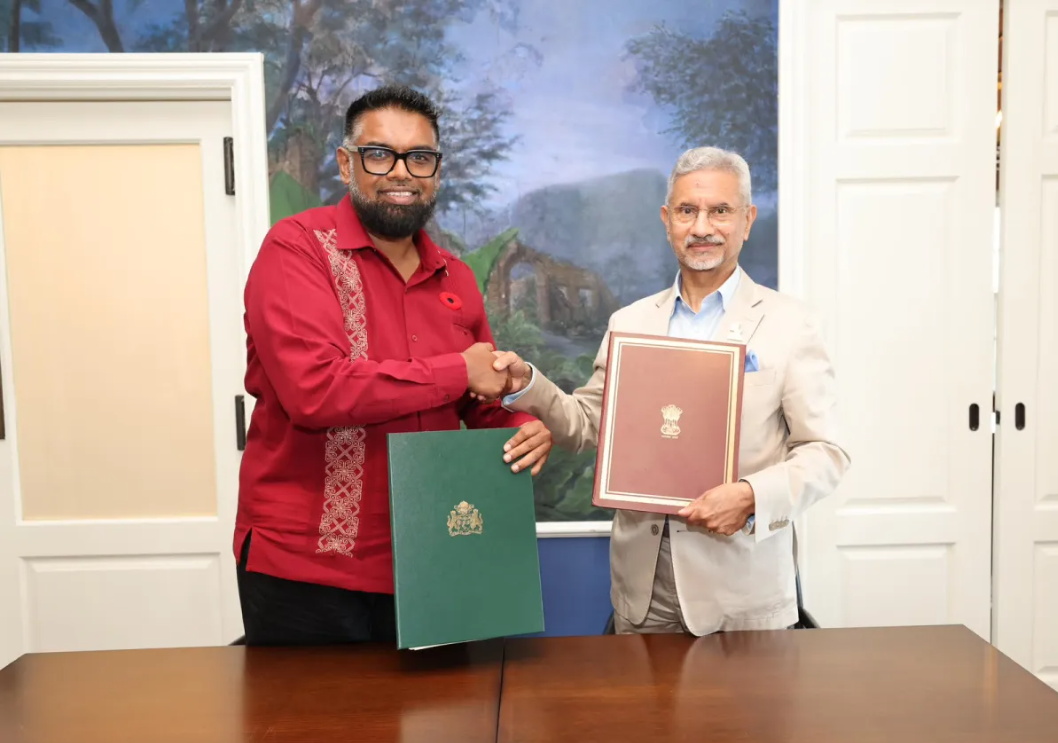
Caption: President Irfaan Ali and India’s Minister of External Affairs, Dr Subrahmanyam Jaishankar
In Brief
- Bilateral Pacts: Guyana and India signed three agreements at CHOGM in Antigua and Barbuda, focusing on digital payments, micro and small enterprises, and community projects.
- Digital Upgrade: India will help Guyana launch a modern national payment system—similar to India’s UPI—by the end of 2026.
- Major Financing: Guyana also secured a US$500 million line of credit from India to fund transformative projects in road infrastructure, healthcare, and defence.
GEORGETOWN, Guyana (CMC) – Guyana has formalised three bilateral agreements with India to advance its digital infrastructure, expand opportunities for micro and small enterprises, and support community-driven development.
President Irfaan Ali and India’s Minister of External Affairs, Dr Subrahmanyam Jaishankar, signed the agreements earlier this week in Antigua and Barbuda on the sidelines of the 28th Commonwealth Heads of Government Meeting (CHOGM).

The agreements comprise a memorandum of understanding (MoU) on Indian Grant Assistance for the Implementation of Quick Impact Projects (QIPs); an MoU on the Supply and Installation of Micro and Small Enterprises (MSEs) Manufacturing Projects; and an agreement on Cooperation in Digital Public Infrastructure and the Functioning of a Unified Payments Interface (UPI)-like system in Guyana.
A major component of the partnership is the development of a modern national payment system, which is expected to improve the efficiency of financial transactions, lower the cost of doing business, enhance financial security, and increase transparency.

President Ali said the system is slated to launch by the end of 2026, with India providing technical expertise to support its implementation. He added that more than 20 Guyanese will benefit from practical training in India’s UPI environment.
“Through this agreement, we will unleash the power of innovation and create that synergy and partnership between our own innovators in Guyana and your innovators, especially in new technology, new systems and accelerating development,” President Ali said.
The QIPs agreement will provide a framework for grant-supported initiatives targeting community development priorities, while the MSE agreement will facilitate manufacturing projects that support entrepreneurship, technical capacity, and local employment generation.
The head of state also acknowledged India’s contribution to human capital development, technology transfer, and the expansion of essential services, noting that the agreements reflect considerable work by both governments to translate bilateral cooperation into practical outcomes.
“These are delivering on the commitment that Prime Minister Modi made when he had come to Guyana when we had this meeting with CARICOM,” Dr Jaishankar said.
Meanwhile, President Ali has welcomed a US$500 million line of credit from India, which will finance transformative investments in Guyana’s road infrastructure, healthcare, and defence sectors.
He noted that the credit facility would support major infrastructure works, including roads that will open up thousands of new homes and house lots, as well as improvements to main highways.
“We are very pleased that we can conclude also our discussions on the next phase of investment by India into Guyana, the US$500 million line of credit, which will cover transformative infrastructure,” President Ali said.
The financing marks the next phase of India’s investment cooperation with Guyana and fulfils a commitment made by Indian Prime Minister Narendra Modi during his visit to the country in November 2024.
In confirming the decision to extend the facility, Dr Jaishankar said that both governments would now work towards developing specific projects under the financing arrangement.