
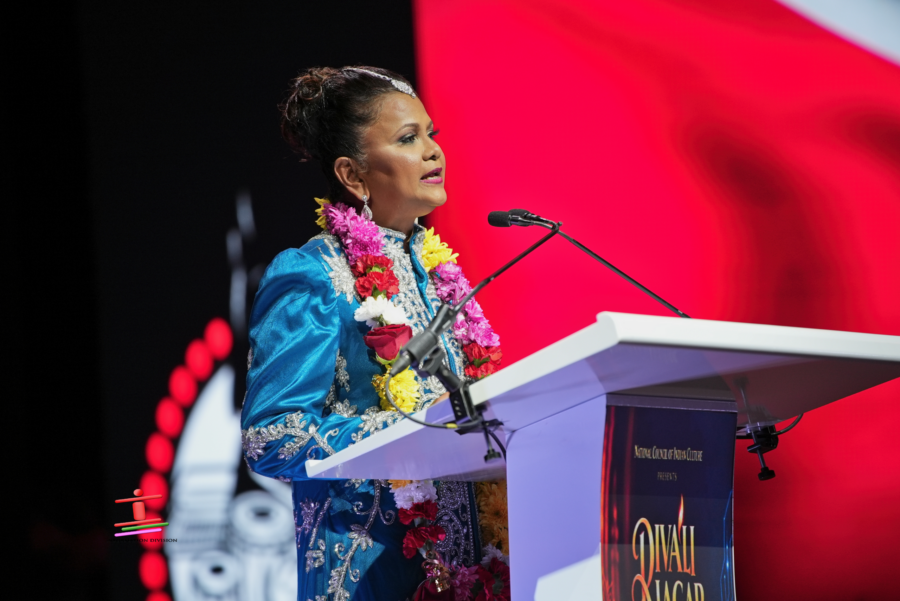
Caption: President Christine Kangaloo
In Brief
- The Event: President Christine Kangaloo delivered the feature address on Tuesday during the sixth night of the 40th Annual Divali Nagar celebrations.
- The Message: Speaking on the theme Viveka – Discerning Truth in the Age of AI, she urged citizens to practise wisdom, source-checking, and discernment as AI makes falsehoods appear increasingly authentic.
- Youth & Education: Kangaloo said that young people must remain intellectually independent and not allow AI to replace critical thinking or their authentic voices.
- The Way Forward: While warning against its misuse, the President noted that AI is ‘not the enemy’ and called for it to be governed wisely so that its benefits remain inclusive, transparent, and accessible to all communities in Trinidad and Tobago.
By Alicia Chamely
Artificial Intelligence (AI) must remain transparent, inclusive, and accountable, and it must serve human dignity, says President of the Republic of Trinidad and Tobago Christine Kangaloo. She urged the responsible use of the technology and called for greater discernment at a time when AI is increasingly used to mislead rather than empower.
Delivering the feature address on the sixth night of the 40th Annual Divali Nagar celebrations on Tuesday, Kangaloo spoke on the challenges and benefits of AI within the context of the Nagar’s theme, “Viveka – Discerning Truth in the Age of AI.”

“This year’s theme, ‘Viveka – Discerning Truth in the Age of AI,’ joins ancient wisdom to one of the defining questions of our time: how are we to remain faithful to truth when artificial intelligence can create false words, false images and false voices that appear real?” she asked.
“Viveka,” she said, “is the faculty of discernment: the union of intellect, conscience and wisdom by which we distinguish truth from falsehood and choose responsibly.”
Kangaloo noted that humanity had been called to discern the truth long before the advent of AI, adding that the struggle to separate truthfulness from deception is nothing new.
She said, “We were wrestling with deception, prejudice and the abuse of power long before the first machine learned to imitate a human voice.”
Reminding the crowd that AI is a human creation and not “some self-originating, moral actor standing apart from us,” she emphasised that humans decide how it is used, and that human choice remains embedded in its creation and deployment.
Kangaloo said, “The machine did not invent the lie, prejudice or cruelty. What it can do is give old human failings unprecedented speed, scale and credibility. It can make untruth look authentic and place an innocent person’s likeness or voice into words and actions that were never theirs. The truth is that AI does not create our brokenness; but it can magnify its consequences.”
“Before we believe, react or share, we must ask where information came from, whether it can be confirmed independently, and whether our eagerness to believe it arises from evidence – or merely from its agreement with what we already wish to be true,” she added.
Kangaloo said this is where discernment and the wisdom to separate truth from deception become imperative.
She said, “The defining question is not simply whether machines will become more intelligent, but whether human beings will become more discerning. Will we use these extraordinary tools to enlarge knowledge and opportunity, or to manufacture deception and deepen exclusion? The answer will not be found in technology alone, but in the quality of our judgement and the courage with which we remain faithful to truth, and to the pursuit of ‘Viveka.’ Our challenge is to let artificial intelligence enlarge our capacities, but never replace our conscience; to let it assist our judgement, but never excuse us from exercising it.”
While cautioning against the pitfalls of AI, Kangaloo also spoke of its advantages in youth development.
On its use in education and among the youth, she said, “When it comes to AI and young people, I believe that our young people must learn not merely to operate intelligent machines, but to remain intellectually independent in their presence. AI can assist research and overcome barriers to learning; but an answer generated is not necessarily an answer understood. Education in the age of AI must therefore cultivate curiosity, source-checking, ethical judgement and confidence in their own authentic voices.”
Speaking of its broader benefits, Kangaloo said, “I think it would also do us well to recognise that AI is therefore not the enemy. It can advance medical research, improve education, assist persons with disabilities and help us solve problems of enormous complexity. We should neither fear it blindly nor embrace it uncritically, but govern and use it wisely.”
“As Trinidad and Tobago embraces artificial intelligence, we must ensure that its benefits do not belong only to those with wealth, technical expertise or access to the best-resourced institutions. AI must serve human dignity, not reproduce old prejudices in new forms, and must remain transparent enough to be questioned, accountable enough to be corrected and inclusive enough to serve every community,” the president said.
She said, “In the age of AI, may that ancient Sanskrit prayer continue to guide us: from the unreal to the real; from darkness to light; from ignorance to understanding. And may the light that we kindle in our deyas also kindle within us the wisdom to recognise truth, the courage to speak it responsibly, and the humanity to use it for the good of all.”