
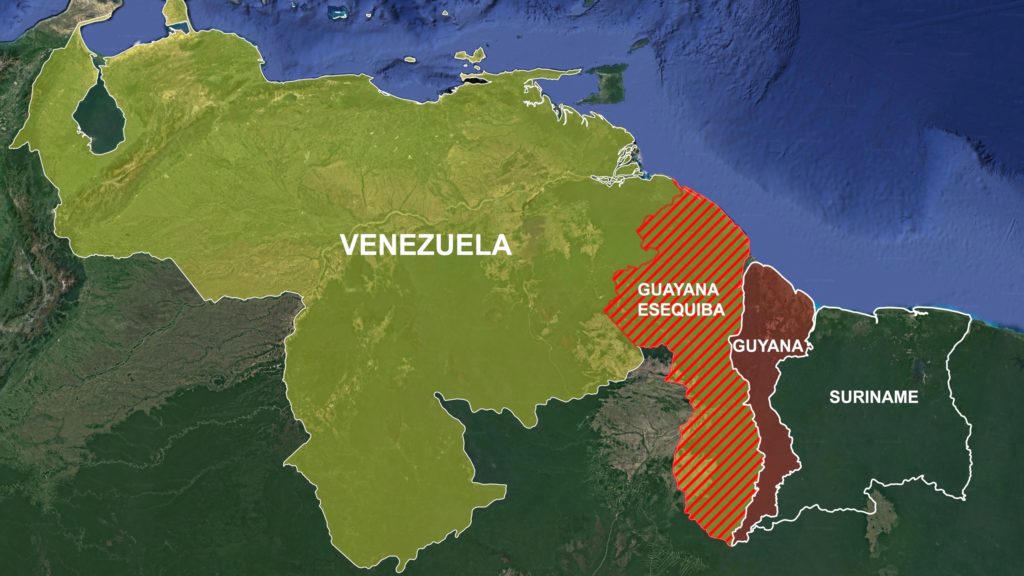
Caption: The Essequibo, which is rich in gold, diamonds and bauxite, has been claimed by Venezuela for more than 180 years
In Brief
- The Proposal: According to a Reuters report, former US State Department official Jeremy Lewin alarmed Guyanese officials in September by suggesting Guyana consider allowing Venezuela partial control of the resource-rich Essequibo region.
- White House Authorisation: Lewin confirmed holding preliminary talks with both nations, stating the discussions were authorised by the White House following a May letter from Venezuela’s acting President Delcy Rodriguez to US President Donald Trump seeking mediation.
- Official US Stance: Following the report, the US State Department maintained that Washington’s official position on the Venezuela-Guyana territorial boundary has not changed.
GEORGETOWN, Guyana (CMC) – Guyanese officials were reportedly alarmed after a senior Trump administration official suggested that Guyana consider allowing Venezuela to take partial control of the disputed Essequibo region, prompting Washington to reaffirm that its position on the countries’ territorial boundary had not changed.
A Reuters report on Wednesday, citing three people familiar with the matter, said Jeremy Lewin, then the US State Department’s director of policy planning, raised the possibility during discussions with Guyanese officials in Washington in September.
The report said Lewin had also suggested that he could help arrange territorial talks between Guyana and Venezuela’s acting President Delcy Rodriguez.

Two sources told Reuters that Lewin had floated the idea of Venezuela assuming partial control of the Essequibo, which accounts for about two-thirds of Guyana’s territory.
Lewin, in an interview with Reuters, confirmed holding preliminary discussions with representatives of both countries about the longstanding territorial dispute. He said the conversations were authorised by the White House and followed a May letter from Rodriguez to US President Donald Trump seeking American mediation.
According to Lewin, Rodriguez also raised the issue with him during a meeting in Caracas in July.
A US State Department official, responding to questions from Reuters, said the department received different policy proposals from outside parties, but maintained that its position on the Venezuela-Guyana boundary had not changed.
The White House referred questions to the State Department without addressing whether it had directed discussions about the future of the Essequibo or received a letter from Rodriguez.
The Guyanese and Venezuelan governments did not respond to Reuters’ requests for comment.
Guyana has consistently maintained that the status of the Essequibo is not open to negotiation. The territory, which is rich in gold, diamonds and bauxite, has been claimed by Venezuela for more than 180 years.
The dispute intensified following major oil discoveries offshore Guyana in 2015. Georgetown subsequently approached the International Court of Justice (ICJ) in 2018, seeking confirmation of the boundary established by an 1899 arbitration award.
Venezuela has continued to press its claim, including at the United Nations General Assembly in September, where Rodriguez called on Guyana to enter negotiations over the territory’s legal status.
The reported discussions come amid a significant improvement in relations between Washington and Caracas following a US operation in January that resulted in the capture of former Venezuelan president Nicolas Maduro.
Rodriguez, who served as Maduro’s vice-president, has since led the Venezuelan government. On Wednesday, US Defence Secretary Pete Hegseth met with her in Caracas and signed an agreement to strengthen military cooperation between the two countries.