
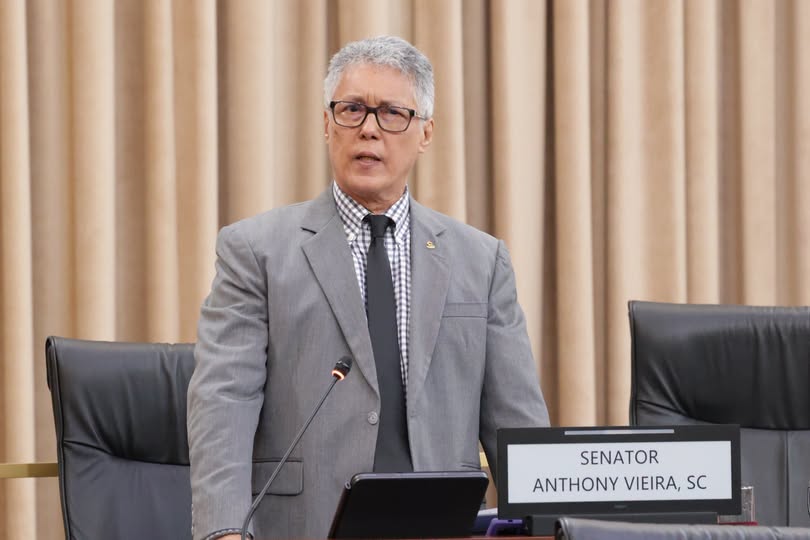
- Constitutional Silence. Independent Senator Anthony Vieira, SC, says that while the Constitution grants the Senate President a casting vote, it does not explicitly dictate how it must be used.
- Law vs Convention. Vieira says the crucial difference between legally enforceable rules and traditional parliamentary conventions, noting that breaking a convention does not necessarily break the law.
- Legal Authority Affirmed. While the adherence to convention is debatable, Vieira clearly stated that Senate President Wade Mark had the absolute legal authority to cast his deciding vote.
- Recent Controversies.The national debate stems from Mark breaking 15-15 ties in favour of the Government to pass both the Special Operations Bill 2026 and the Procurement Amendment Bill.
- Defending the Vote. President Mark continues to defend his actions, asserting there is no settled parliamentary practice in Trinidad and Tobago regarding the preservation of the status quo.
By Prior Beharry
In a statement on the casting vote controversy, Independent Senator Anthony Vieira, SC, says while the Trinidad and Tobago Constitution gives the Senate President a casting vote, it does not say how it should be used.
On Wednesday, Vieira said, “I do not propose to express a personal view on whether the President’s decision was right or wrong.”
He added, “But I do think the present controversy provides a useful opportunity to understand an important feature of our constitutional democracy: not everything that governs the conduct of constitutional office holders is found in written law, and not every departure from convention amounts to a breach of law.”
Vieira said there must be a distinction between written law and constitutional convention.
He said, “The Constitution expressly gives the President of the Senate a casting vote where the votes are equally divided. It does not prescribe how that casting vote must be exercised.”

He acknowledged the long-established Westminster parliamentary convention—often referred to as the Denison Principle—where a presiding officer ordinarily votes to preserve the status quo, allow further discussion, and avoid effecting substantive change without a clear majority.
However, Vieira noted, “A constitutional convention is not the same thing as a rule of law. Conventions develop from history, parliamentary practice and constitutional understandings. They can be extremely important to the proper functioning of our constitutional system without necessarily being legally enforceable.”
Vieira posed two distinct questions arising from the Senate’s events: “The first is whether the President had the legal authority to cast the deciding vote? In my view, most certainly, he did. The second is whether the casting vote was exercised consistently with the Parliamentary Conventions which should guide the holder of that office? On this question there is legitimate room for debate. We should be careful not to confuse the two.”

His remarks highlight the main legal question now facing Trinidad and Tobago: since the country’s Constitution is supreme, does the Senate President actually have an “unqualified casting vote?”
While Trinidad and Tobago operates under a supreme Constitution, the United Kingdom operates under parliamentary sovereignty. This divergence was thrust into the spotlight during the contentious passage of the Special Operations Bill 2026 during the wee hours of Republic Day. The Senate was divided 15–15 on the government-backed security legislation. At the end of the debate, all 15 Government Senators voted “aye,” while the six Opposition Senators and the nine Independent Senators voted “no.” Senate President Wade Mark then cast the deciding vote in favour of the Government, voting “yes,” to pass the bill.
Just minutes earlier, Mark had voted “no,” to defeat an amendment proposed by Independent Senator Desirée Murray that would have made body cameras worn by police mandatory. In that instance, he cited the need to maintain the status quo.
On Monday, Mark again cast his deciding vote to secure the passage of the Government’s Public Procurement and Disposal of Public Property Amendment Bill amid another 15-15 tie. When Opposition Senators called for Mark’s reasons, he stood by his previous rationale.
Defending his decision, Mark stated there was “no settled practice in this Parliament … on this issue of the status quo re casting vote.”