
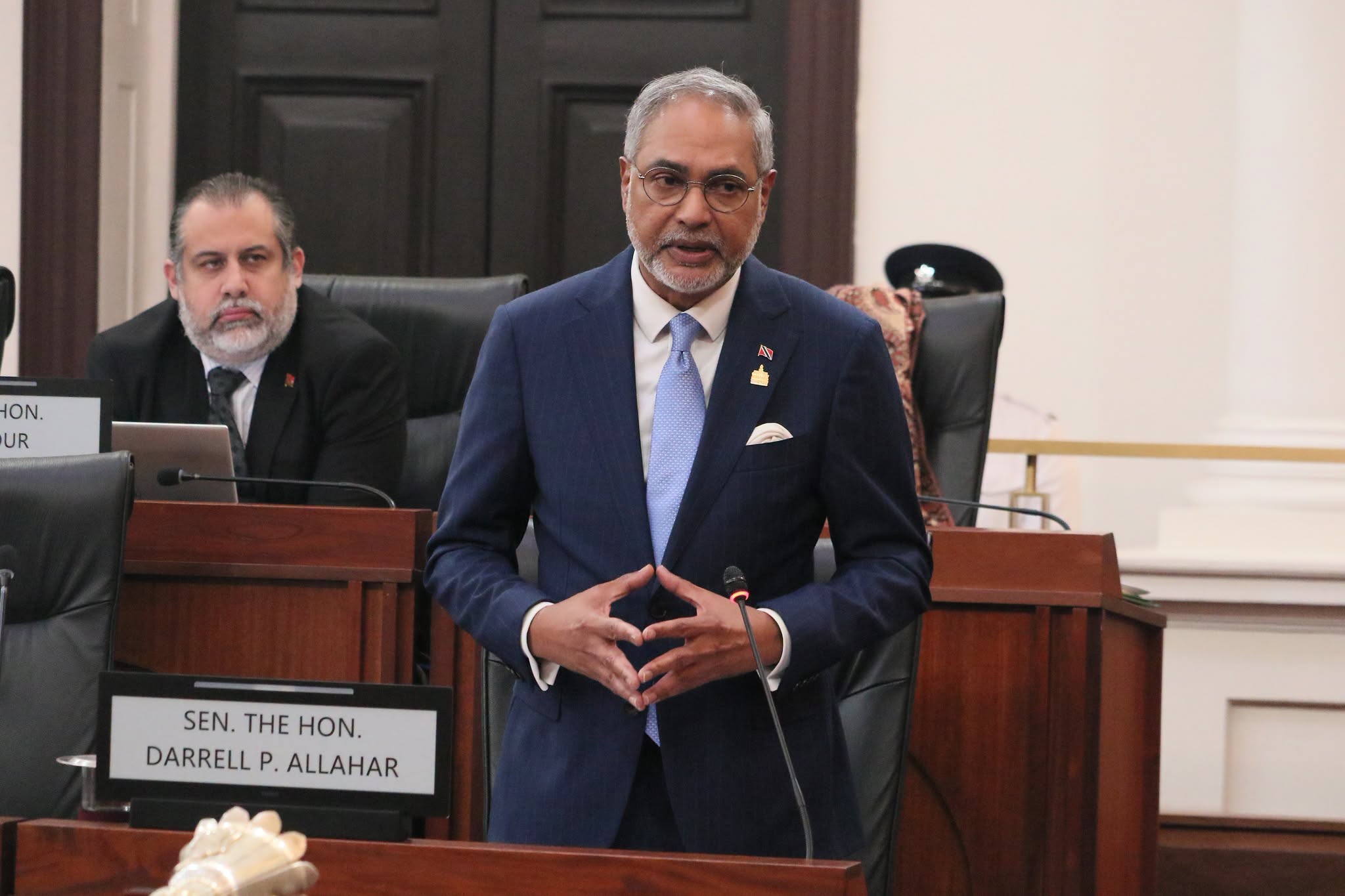
By Prior Beharry
Leader of Government Business in the Senate, Darrell Allahar, has strongly defended Senate President Wade Mark’s recent use of the casting vote.
He has dismissed the ensuing public uproar as “amusing,” and rejected reliance on British parliamentary conventions.
In a statement issued on Wednesday, Allahar threw his weight behind the constitutional supremacy argument, pushing back against critics who claim the Senate President breached established traditions.

“It is actually quite amusing to witness the fluttering and flapping over the use of the casting vote in the Senate. V.S. Naipaul would have been amused,” Allahar remarked.
The controversy stems from recent sittings where the Senate was deadlocked 15-15. Senate President Wade Mark used his casting vote to break the tie in favour of the Government, securing the passage of both the contentious Special Operations Bill 2026 and the Public Procurement and Disposal of Public Property Amendment Bill. Critics have argued that Mark should have followed the Denison Principle—a UK House of Commons convention dictating that a presiding officer should vote to preserve the status quo rather than pass substantive legislation.
However, Allahar dismissed this reliance on foreign traditions.
“There has been a lot of discussion about the Standing Orders, which incorporate the practice of the House of Commons (where applicable), and to talk about conventions and settled practice,” he said.
Allahar said, “The fundamental and for some, the ‘inconvenient’ truth is that section 59(2) of the Constitution gives a President of the Senate a casting vote in the case of deadlock. That provision says that in such a case, he shall ‘have and exercise’ a casting vote.”
He said that commentators acknowledging Section 59(2) still appear to be “infatuated with Westminster.”
Allahar said that the Constitution mandates the exercise of the vote without imposing any restrictions.
He said, “No ‘convention’ or practice has been referenced. Just clear words, which say in case of a tie, a President must break the deadlock either way, in his/her own judgment.”

Addressing the argument that a tie should result in no change, Allahar pointed to the intent of the Constitution’s drafters.
He said, “The framers of the Constitution could have not given a President a casting vote, which would mean a tie would automatically preserve the status quo. What they did instead was give a President a choice, in order to break a legislative deadlock.”
Taking aim at the continued deference to British parliamentary norms, Allahar said, “After 50 years as a Republic, some are still invoking the practice of the House of Commons and talking about conventions and preserving the ‘status quo’. Some of them are on record as saying we must ‘complete the cycle of independence’.”
He said, “The Red House is not Westminster. The Trinidad Senate is not the UK House of Commons. It certainly is not the UK House of Lords. Attempts by some to recreate a neocolonial aristocracy should keep this in mind.”
Allahar claimed that the 1976 Constitution, passed under the PNM when there was no effective opposition, remains the ultimate authority.
He said, “It became the Supreme Law of this country, and Standing Orders and so-called ‘conventions’ must yield to its provisions. Any honest analysis should start there, and not in the Palace of Westminster.”