
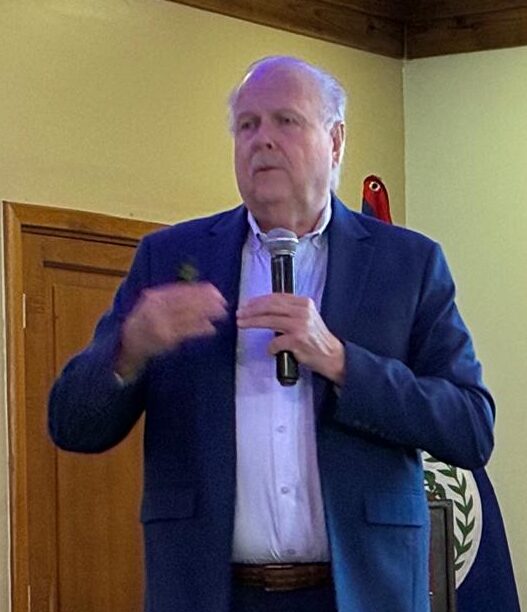
Caption: Luis Ajamil
In Brief
- Mega-Ship Reality: Speaking at a briefing in Belize City on Wednesday, Bermello Ajamil and Partners CEO Luis Ajamil warned that traditional, legacy Caribbean ports are struggling to raise capital and accommodate the industry’s shift toward mega-ships.
- Surging Caribbean Demand: With shipyards at full capacity and 186,000 new cruise berths currently on order globally, cruise lines are deploying the vast majority of their new vessels to the highly profitable Caribbean market.
- Destination Shortfall: Ajamil noted that as US homeport berths expand from 41 to 49, the region will require between 107 and 147 capable destinations—creating a major opening for purpose-built, environmentally sustainable developments like Belize’s planned Olo Caye project.
BELIZE CITY, Belize — Caribbean cruise destinations that fail to build infrastructure capable of handling mega-ships risk being left behind as global cruise lines deploy a record wave of larger vessels into the region, a leading maritime architect said on Wednesday.
Speaking at an informational briefing in Belize City on the planned Olo Caye port development, Luis Ajamil, Chief Executive Officer of global design firm Bermello Ajamil and Partners, outlined the shifting economics and passenger expectations driving the modern cruise industry.
Ajamil noted that while cruise lines remain heavily focused on economics—especially as they pay down pandemic-era debt—their primary driver is guest satisfaction to secure repeat business.

“The whole idea of going to an island as they did before and just landing there, and everything is a mess—that’s not what everybody is looking for,” Ajamil told local business executives and the media. “They want that authentic experience, but they want it in a way that’s organised.”
The decline of legacy ports
According to Ajamil, traditional historic ports across the Caribbean—such as St Thomas and San Juan—have struggled to adapt to surging passenger volumes and larger vessel sizes.
“They were historic and authentic until there were so many ships that, basically, that growth disintegrated the experience,” he explained.
Ajamil said, “Everybody started offering the same T-shirts, the same stuff, and the value is not there. So, guest satisfaction is highly variable, and those ports can’t raise the capital to support a bigger ship. They’re really struggling.”
While cruise lines have responded by building their own self-contained private island enclaves, Ajamil said the future lies in purpose-built destinations that combine high-capacity engineering with authentic local experiences.
“The trends are that if you can’t handle big ships, then your numbers are not ever going to work,” Ajamil said.
He noted that original four-berth concepts capable of accommodating mega-ships require rigorous, data-driven planning to manage daily passenger swings that can range from 5,000 visitors with a single vessel to nearly 28,000 passengers when four mega-ships dock simultaneously.

“Without proper planning, it won’t work. You’ve got to have the right transport; you’ve got to have everything,” he said, adding that new developments in Belize must be unique and “environmentally proof.”
“In fact, it should be adding value to the environment,” he said.
Ajamil said, “It should be one of those where people say, ‘That’s Belize, and that’s where I want to go.’”
A booming Caribbean market
Despite rebounding post-pandemic with ships sailing at over 100 per cent capacity and generating record revenue per passenger, the cruise sector still accounts for just two per cent of global travel, leaving massive room for expansion.
Ajamil pointed out that the Caribbean remains the world’s largest and most profitable cruise market, outpacing the rest of the globe combined in passenger growth.
“The deployment announcements of where they’re going—the ships that are being redeployed or coming out of the shipyard—they’re all going into the Caribbean,” he said.
Globally, shipyards are operating at maximum capacity, delivering 10 to 12 vessels a year with a five-year waiting list for new orders. Currently, there are 186,000 new passenger berths on order worldwide, almost all of which are on larger-scale ships that traditional ports cannot easily accommodate.
A critical shortage of destinations
While the Bahamas has increasingly dominated traffic in the Eastern Caribbean, Belize is strategically positioned to capture Western Caribbean itineraries fed by major US Gulf Coast homeports such as Galveston, New Orleans, and Tampa, alongside Florida hubs in Miami and Port Canaveral.
However, Ajamil warned that the region faces a severe mathematical shortfall in port capacity.
Across the US homeports feeding the Caribbean, there are currently 41 operational berths—meaning 41 ships depart every Saturday—a number set to rise to 49 based on terminals currently under construction.
Because many of those ships operate short three- or four-day itineraries rather than seven-day voyages, they require multiple port calls per week.
“You need between 107 and 147 destinations in this region,” Ajamil said. “They don’t exist.”