
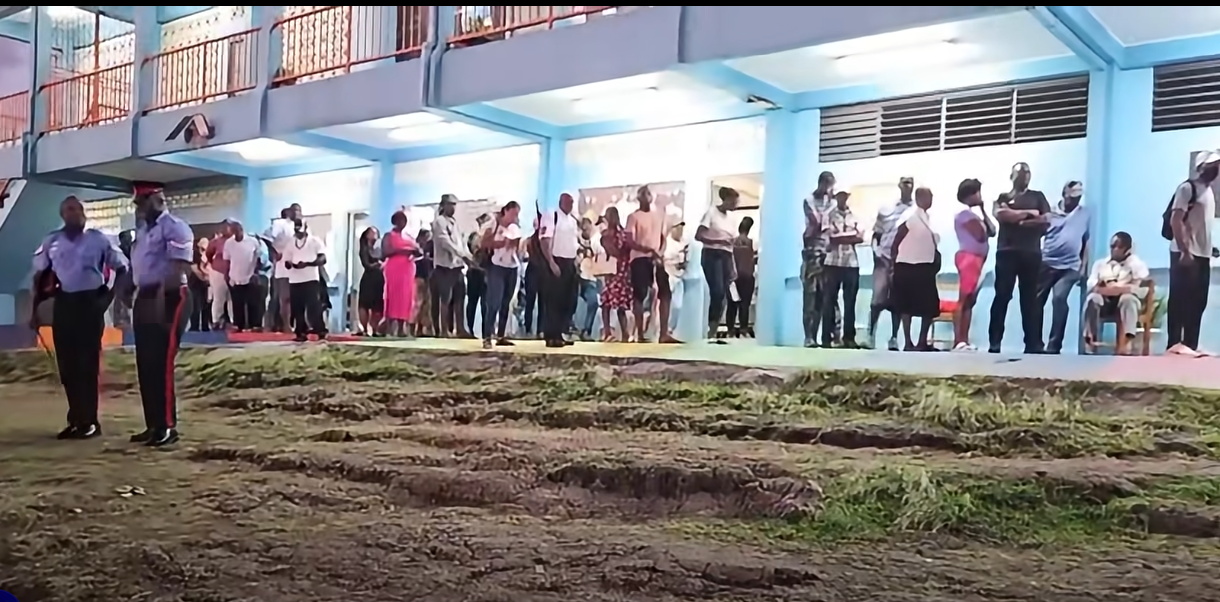
Caption: Long lines formed at the Calliste Government School as Grenadians prepare to cast ballots to elect a new government Photo: CMC
In Brief
- Grenadians voted on Thursday in a general election that at least one opinion poll suggests could be a dead heat, with turnout and undecided voters likely to decide the outcome.
- Prime Minister Dickon Mitchell’s National Democratic Congress (NDC) is seeking another term against the New National Party (NNP), led by Emmalin Pierre, who has promised tax relief within her first 100 days.
- There are 97,020 registered voters and 46 candidates contesting 15 seats, with first results expected within two hours of polls closing at 5.00 pm.
ST GEORGE’S, Grenada (CMC) – Grenadians are voting in a general election on Thursday that at least one opinion poll suggests could be a dead heat, with voter turnout and the choices of undecided and politically unaffiliated voters likely to determine which party forms the next government.
The Parliamentary Elections Office (PEO), which has said it is fully prepared for the election, said there are 97,020 registered voters, an increase of 9,454 on the 87,566 registered electors in the 23 June 2022 general election.
There are 46 candidates contesting the 15 seats in Parliament. Polls opened at 6 am (local time) and will close at 5 pm, with the first results expected within two hours of the close.

Prime Minister Dickon Mitchell, who is leading his National Democratic Congress (NDC) into the election a year ahead of the constitutional deadline, is asking the electorate to give his party, which won the June 2023 poll by a 9-6 margin, another opportunity to steer the future direction of Grenada, Carriacou and Petite Martinique.
“Four years ago, you entrusted me with the responsibility of serving as your Prime Minister. It was an honour then, it is an honour now, and it is a responsibility I have never taken lightly,” Mitchell said in a national broadcast on the eve of the polls.
Mitchell, an attorney, reminded voters that “leadership is not what we say when the camera is on. It is what we are prepared to do when difficult decisions must be made.

“It means having the courage to engage in difficult national conversations, particularly when those conversations are uncomfortable. It means being consistent in principle, whether speaking in public or behind closed doors,” he added.
However, Emmalin Pierre, the first woman to lead the main opposition New National Party (NNP) into a general election, after its founder and former prime minister Dr Keith Mitchell officially bowed out of active politics this year, is promising relief within her administration’s first 100 days in office. Her pledges include removing taxes on electricity and sugar, abolishing the water levy and exempting monthly incomes of EC$6,000 (One EC dollar = US$0.37) or less from income tax.
“Our plan will put money back in your pocket and put Grenada back on track,” she said, also pledging tax-free Christmas bonuses this year, rent-to-own housing and National Health Insurance.
In her broadcast, Pierre said economic growth, improved revenue collection and reduced waste would finance the programme. She is facing a challenge from Education Minister David Andrew, whom she defeated by just over 200 votes in the 2023 general election.
Former foreign affairs minister Peter David, who has contested elections in the past for both the NDC and the NNP, is leading his newly formed Democratic People’s Movement (DPM) into the election. He is contesting the Town of St George seat, which he has represented for more than 20 years, having first been elected in November 2003.
“I believe that Town of St George is an example, a shining example of people from both parties coming together for their constituency,” David told DPM supporters.
Political observers say his seat will attract particular attention, given that David has never lost an election he has contested there, and he could emerge as a kingmaker should the opinion polls prove correct.
An opinion poll conducted by the North American Caribbean Teachers Association (NACTA) predicts a closely contested election, with voter turnout and the choices of undecided and politically unaffiliated voters likely to determine which party forms the next government.
The New York-based NACTA said the majority of the 1,285 voters polled are leaning towards political change.
According to NACTA, 47 per cent favour Pierre as prime minister, four percentage points more than Mitchell, while David, whose DPM is contesting nine seats, trails at four per cent. Six per cent did not reveal their choice.

NACTA said Grenada’s relations with the United States have become a particularly sensitive issue in the campaign.
“American visa restrictions and their reported consequences for Grenadian nationals have generated anxiety and frustration among sections of the population. Artistes have complained about difficulties obtaining visas and the necessary approvals to travel to the United States for performances. Others are concerned about obstacles to visiting relatives, maintaining family connections and conducting personal and professional business in America.
“For many Grenadians, these concerns have transformed relations with Washington from an abstract foreign-policy issue into a matter affecting families, politicians, livelihoods and opportunities,” NACTA said.
The polls are being monitored by observer teams from the Organization of American States (OAS) and the Caribbean Community (CARICOM).