
In Brief
- The Claim: Opposition MP Stuart Young questioned whether the government changed its natural gas allocation policy to divert gas from Point Lisas petrochemical plants to Atlantic LNG.
- The Rebuttal: Energy Minister Dr Roodal Moonilal firmly denied any policy change or diversion of gas to Atlantic LNG.
- The Data: NGC met its supply obligations 95% of the time in 2026. Petrochemical customers actually received 33% above their contractual entitlements in aggregate.
- The Real Issue: Shortfalls experienced by downstream plants were largely due to 20 separate plant upsets since January 2026, not a lack of gas availability. Furthermore, renewed 2026 contracts maintained or increased daily gas quotas.
By Prior Beharry
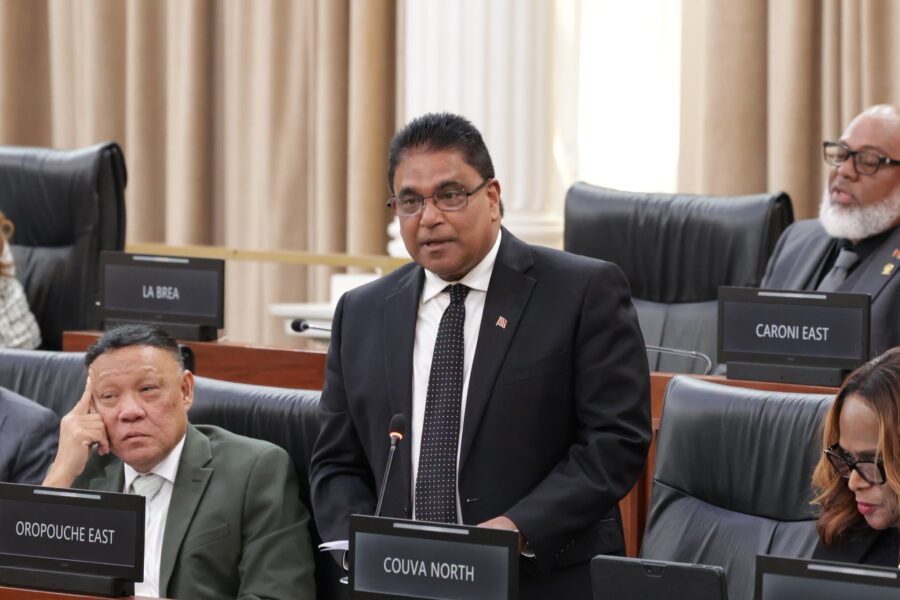
Minister of Energy Dr Roodal Moonilal says natural gas was not being diverted from Point Lisas petrochemical customers to the Atlantic LNG facility.
He was responding to a question in the Lower House on Friday from Port-of-Spain North/St Ann’s West MP Stuart Young.
Moonilal said, “It is quite ironic that this question is being asked by persons who, when they were in charge of the energy sector, took no meaningful steps to secure a guaranteed supply of gas to the downstream petrochemical sector,”

He said, “The policy of this government is diametrically opposed to that which existed previously under those opposite.”
The Minister stated that since April 2025, the National Gas Company (NGC) has taken “positive and meaningful steps to reverse the damage to the downstream petrochemical sector” and that the country is now seeing the results of those initiatives.
Addressing Young’s specific questions regarding a change in the national natural gas allocation policy and Cabinet approvals, Moonilal clarified that the NGC has not altered its allocation to petrochemical customers and is “not aware of any diversion of gas from those customers to the Atlantic LNG Facility.”
As the sole aggregator of natural gas for the domestic market, Moonilal noted that NGC has fully met its contractual obligations to all domestic customers from 2025 through 2026, while simultaneously satisfying its commitments to Atlantic LNG.
He said that downstream petrochemical contracts were successfully renewed in 2026. Under these new agreements, daily contract quantities (DCQs) were maintained and, in some cases, increased.
Moonilal said, “Notably, the GSC (gas supply contract) for NGC’s largest petrochemical customer by volume was renewed with a DCQ approximately 16% higher than that provided under the expired contract.”
The mimister attributed recent production shortfalls to internal plant issues rather than gas supply shortages.
He revealed that since January 2026, there have been 20 separate downstream plant upsets at the Point Lisas Industrial Estate (excluding Nutrien). These incidents forced plants to shut down or operate below their gas entitlements “for reasons unrelated to gas availability.”

While acknowledging that NGC experienced two gas supply-related constraints in 2026, Moonilal noted that only one resulted in curtailments to petrochemical customers.
This single constraint was linked to a planned upstream activity coordinated with the Atlantic Train 4 scheduled turnaround, he said.
“Despite these constraints, NGC delivered gas at the contracted DCQ level in accordance with the GSCs on approximately 95% of days during the year,” Moonilal stated, adding that petrochemical customers received supplies below their entitlements on only 5% of days.
Far from being starved of gas, Moonilal revealed that since January 2026, petrochemical customers have, in aggregate, “received gas volumes approximately 33% above their contractual entitlements,” excluding one customer constrained by operational issues.
“Accordingly, the available data demonstrates that petrochemical customers at the Point Lisas Industrial Estate consistently received gas supplies at or above their contracted DCQs throughout 2026,” Moonilal concluded. He reiterated that NGC met or exceeded its obligations on 95% of days, proving “there is no evidence that gas allocated to petrochemical customers was redirected to the Atlantic LNG Facility.”