
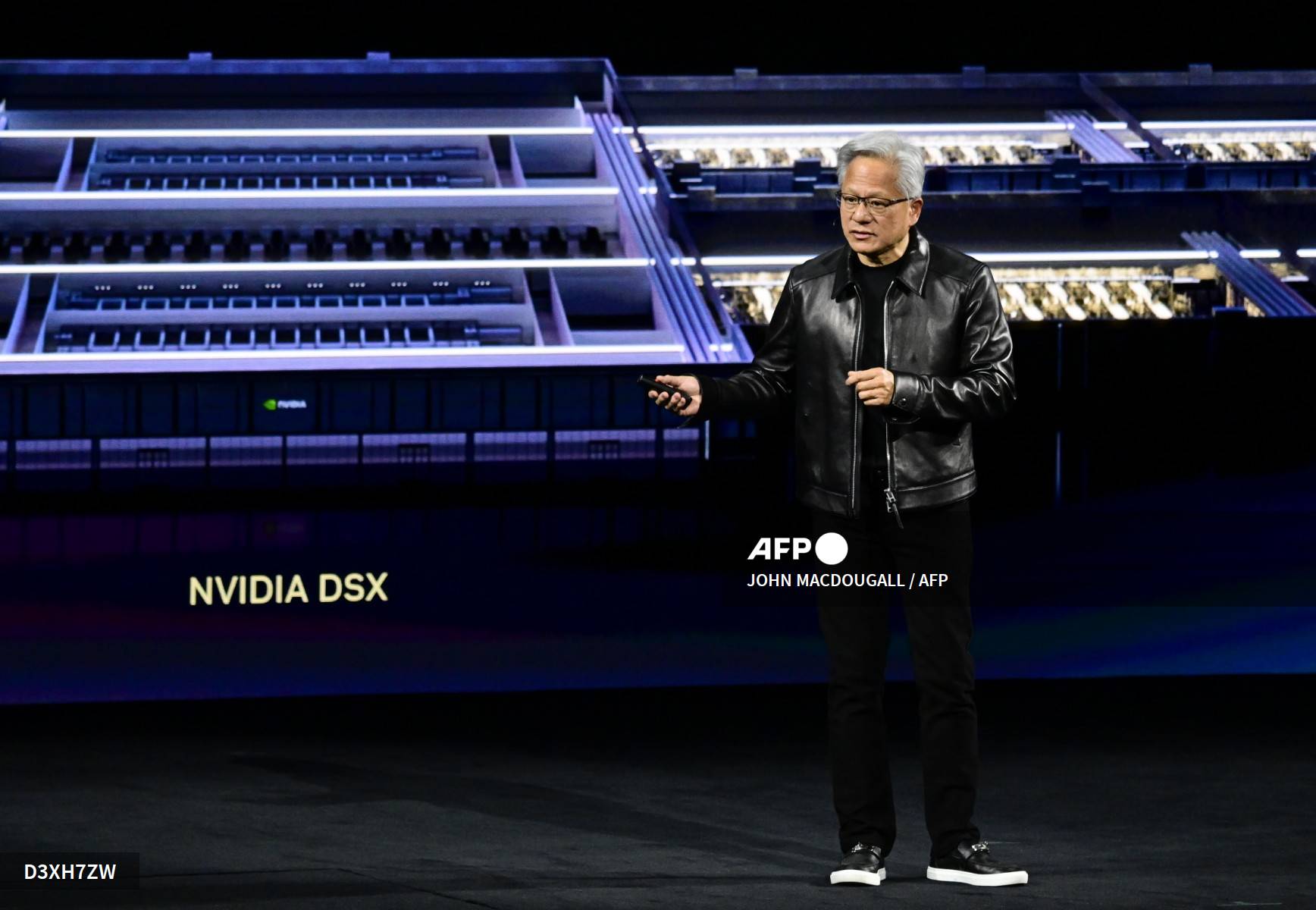
Caption: Jensen Huang
In Brief
- The Investigation: Nvidia’s board has launched an independent inquiry into CEO Jensen Huang after he admitted to an affair with a businesswoman suspected of working for Chinese intelligence.
- The Allegations: According to The New York Times, US intelligence officials concluded that the woman, an executive linked to Singapore-based data centre firm Megaspeed, was funnelling information to Beijing.
- Security Concerns: While Nvidia says there is no evidence that company secrets or national security were compromised, reports suggest the relationship could have exposed President Donald Trump’s thinking on AI ahead of his summit with Xi Jinping.
- Market Fallout: Analysts warn the scandal is a ‘black eye moment’ that will likely trigger congressional inquiries, weigh on Nvidia’s share price, and potentially put Huang’s role as chief executive at risk.
By Elodie Mazein
NEW YORK (AFP) — The board of chip giant Nvidia announced on Sunday that it has opened a probe into chief executive and co-founder Jensen Huang, after he acknowledged an affair with a woman who US officials say was working for Chinese intelligence.
In a message to company employees released on Sunday, the 63-year-old Taiwanese-born billionaire admitted to the affair and apologised to both his family and staff.

“I was unfaithful to my wife,” he said. “My actions hurt her and our children. There is no excuse for what I did. I am deeply sorry.”
In a separate statement, Nvidia said it had opened an independent investigation “in light of recent reporting that founder and CEO Jensen Huang has been the target of a foreign intelligence effort.” While the company did not name a country, the statement added: “While the Board has no reason to believe that either national security or NVIDIA secrets were compromised, the Board’s inquiry will examine all available information.”
Late last month, The New York Times reported that US intelligence officials had concluded the woman—a Chinese executive linked to a Singapore-based data centre company called Megaspeed—had been funnelling information to Beijing.
The executive, Alice Huang—also known as Huang Le, and no relation to the Nvidia boss—developed a close relationship with him, the Times said. Citing unnamed sources briefed on the matter, the newspaper added that Megaspeed was already under scrutiny for allegedly steering Nvidia AI chips to China.
The Chinese government has dismissed the Times report as “groundless speculation.” Asked about the matter on Sunday, US Secretary of State Marco Rubio said he could not comment, describing it as an “internal corporate matter.”

‘Black eye moment’
Jensen Huang is a central figure in the artificial intelligence revolution and is close to President Donald Trump, who has repeatedly spoken out against regulating the industry so as not to let China gain the upper hand in the AI race.
According to the Times, Huang’s relationship with Alice Huang could have given her insights into Trump’s thinking around AI—an issue likely to arise during the US president’s planned talks with Chinese President Xi Jinping at a summit in China later this month. The newspaper noted that Trump was briefed on the intelligence findings roughly a year ago and chose not to act on the information.
Nvidia, a global leader in producing the chips used to train and run AI models, is one of the world’s most valuable companies. Its technology sits at the heart of a battle for tech dominance between Beijing and Washington, which restricts the export of the most cutting-edge silicon chips to China.
Technology analyst Dan Ives, of the investment bank Yorkville Ives, said word of the probe is “a black eye moment” for Jensen Huang, predicting it will at the very least spark multiple congressional inquiries and “create an overhang on the stock for a myriad of reasons.”
In the near term, Huang is expected to keep his job, though he risks being removed as Nvidia’s CEO depending on the outcome of the board’s inquiry, Ives said in a statement.
“This will add risk to the stock as he is so important to the Nvidia story and strategy globally,” he said. “This will also increase major scrutiny regarding selling chips to China, which remains a key battleground issue in DC.”