

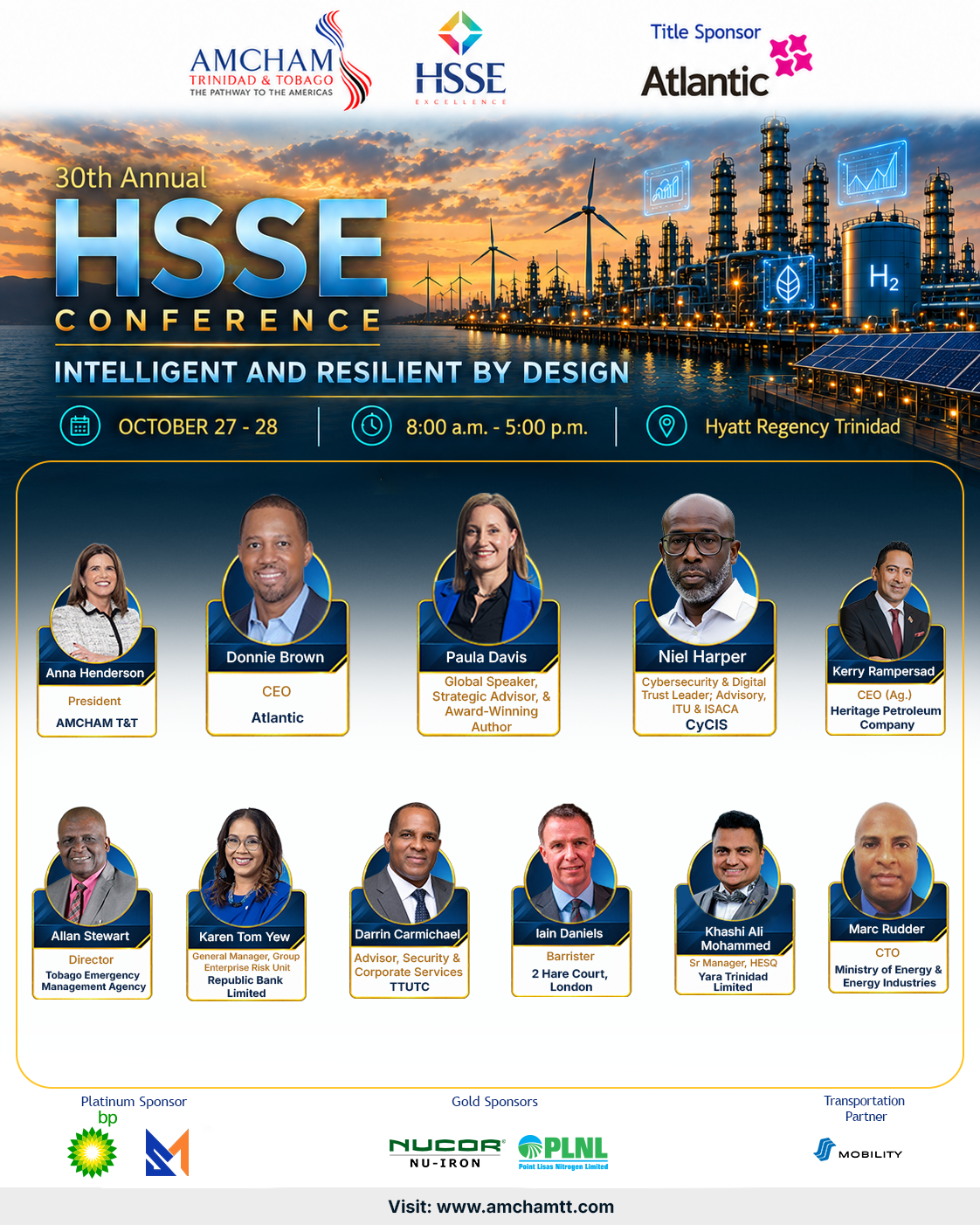
Caption: Om Lalla
In Brief
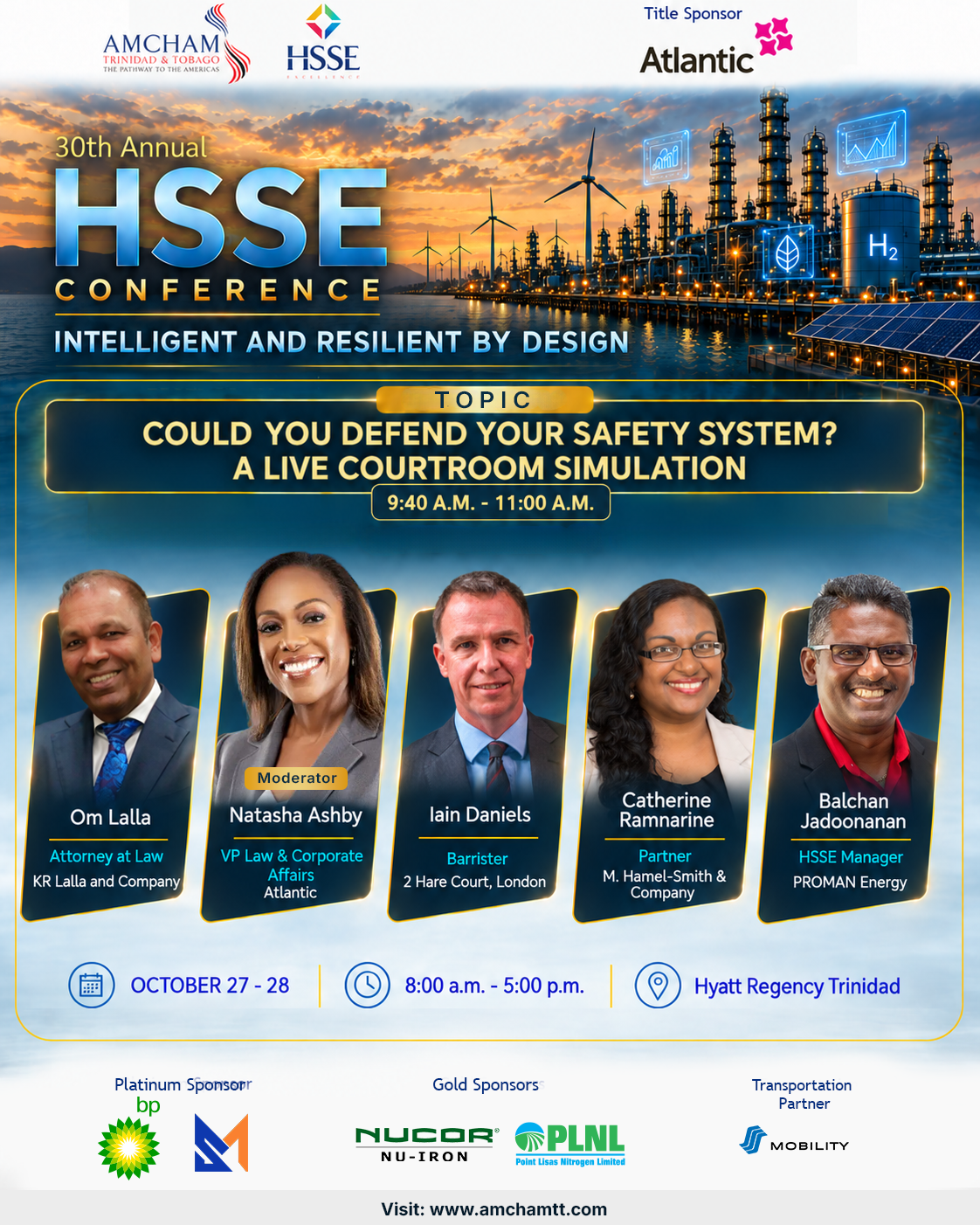
- The Event: Attorney Om Lalla will feature on a live courtroom simulation panel at AMCHAM’s 30th Annual HSSE Conference and Exhibition at the Hyatt Regency.
- The Documentation Gap: Having a safety manual on paper is not enough; companies often fail in court because they cannot provide contemporaneous records proving rules were actively monitored and enforced.
- Executive Liability: Directors cannot simply delegate safety to an HSSE manager and walk away—they must prove they acted on material warnings and verified corrective measures.
- The 24-Hour Trap: Rushing to control the public narrative after an workplace incident often compromises the legal defence before the facts are even established.
- The Digital Trail: While digitising safety logs can strengthen a defence, it also leaves an unforgiving, traceable trail for prosecutors if warnings are ignored.
Attorney Om Lalla will be a panellist at AMCHAM’s 30th Annual HSSE Conference and Exhibition on the topic, “Could you defend your safety system? A live Courtroom Simulation.” The conference takes place at the Hyatt Regency on Wednesday and Thursday.
AZP News Editor-in-Chief Prior Beharry (PB) sent five questions to Om Lalla (OL) ahead of the event. Below are his responses:
1. PB: Mr Lalla, the premise of your courtroom simulation is that in court, success isn’t determined by what an organisation intended to do, but by what it can prove it did. In your two decades of litigation experience in Trinidad and Tobago, what is the single most common “documentation blind spot” or gap that catches local companies off guard when they are called to defend their safety systems under the OSH Act?
OL: The failure to maintain a complete, contemporaneous record showing that the company’s safety procedures were actually implemented, monitored and enforced—not merely written down.
The critical gap is often between having a safety system on paper and being able to prove that the system worked in practice. The issue is not simply whether training was intended or even whether it probably occurred. It is whether the company can substantiate its account with credible evidence.
A safety manual describes what a company intends to do. A defensible safety record demonstrates what it actually did.
2. PB: Many CEOs and directors assume that once they hire an HSSE manager and approve a safety budget, their legal duty is fulfilled. Through the lens of Chapter 88:08 (the OSH Act), where does the buck actually stop in the courtroom, and what does genuine “due diligence” look like for an executive sitting in the witness box under cross-examination?
OL: A director’s strongest position in the witness box is not, “I delegated safety to a competent professional.” It is, “I established a system of competent delegation, received meaningful information about the risks, acted on material warnings and required evidence that corrective measures were completed.”
3. PB: You are frequently brought in to handle high-stakes crisis management. When a serious workplace incident occurs, companies are simultaneously dealing with injured workers, regulatory inspectors and the court of public opinion on social media. What is the biggest mistake leadership teams make in the first 24 hours after an incident that later compromises their legal defence?
OL: The biggest mistake leadership teams make in the first 24 hours is allowing the pressure to control the narrative to overtake the need to preserve evidence, establish the facts and protect the integrity of the investigation.
In a serious workplace incident, management is under immediate pressure from several directions: injured employees and their families need answers, regulators may require information, operations may be disrupted and social media may already be assigning blame.
The instinct is often to issue a reassuring statement, defend the company’s safety record or identify an explanation before the facts are established. That can be a serious strategic error.
From a litigation perspective, the first 24 hours can shape the entire case—not because every mistake made during that period determines liability, but because decisions made under pressure can create evidence that is difficult to explain later.

4. PB: This year’s milestone 30th HSSE conference theme is “Intelligent & Resilient by Design,” which includes adopting smarter technologies and AI in the workplace. As organisations digitise their maintenance logs, risk assessments and monitoring systems, how is that changing the nature of evidence in the courtroom—does digital data protect companies better, or does it create a more unforgiving trail for prosecutors?
OL: The fundamental change is that digitalisation is making workplace safety evidence more traceable, more readily comparable and, in some respects, much harder to explain away.
My view is that digital data can strengthen a company’s legal defence, but it can also give a regulator or prosecutor a far more detailed account of what the company knew, when it knew it, and what it did—or failed to do—in response.
5. PB: When you put a company’s safety system on trial—even in a simulation like this—it forces a hard look at whether safety is treated as a core value or just a “tick-the-box” exercise. Based on the cases you’ve navigated in the Industrial Court and High Court, do you believe corporate Trinidad and Tobago is genuinely becoming more resilient in its safety culture, or are we still largely reactive until charges are laid?
OL: Trinidad and Tobago has made progress in formalising occupational safety and strengthening awareness. However, I would not equate greater regulatory awareness, more sophisticated HSSE systems or declining reported accident figures with a fully embedded safety culture.
The next stage requires a shift in executive thinking. Safety must be treated as an operational and governance responsibility, not merely a compliance function delegated to the HSSE department.
The companies that become genuinely resilient will be those that recognise that preventing an accident is not simply about avoiding prosecution or reputational damage. It is about protecting human life, preserving operational continuity and demonstrating responsible leadership.
Ultimately, the maturity of a company’s safety culture is not measured by how well it responds to a tragedy. It is measured by how consistently it acts to prevent one.