
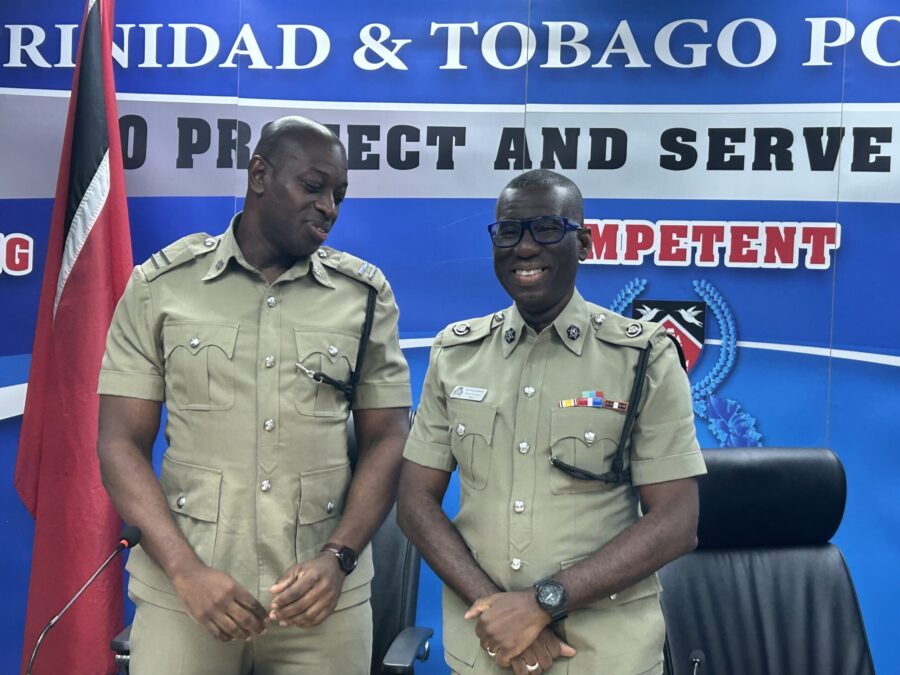
Caption: Assistant Superintendent Owie Russel, left, and Police Academy Senior Superintendent Richard Taylor share a light moment after Thursday’s TTPS media conference. AZP News/A
licia Chamely
In Brief
- New Legislation Strategy: The Trinidad and Tobago Police Service (TTPS) has formulated a comprehensive plan to implement the recently enacted Special Operations Bill 2026.
- Recruitment and Retraining: The police force has attracted 9,100 new applicants, while between 5,000 and 8,000 serving officers have undergone retraining programmes over the past five years.
- Mandatory De-escalation Training: Before participating in special operations, officers are required to complete training in human rights, use of force, and conflict de-escalation.
- Commitment to Public Trust: Police leadership emphasised that the new training ensures officers use their expanded powers lawfully, fairly, and with restraint to build and maintain public trust.
- Body Camera Funding Hurdle: Although all officers are trained to use body cameras at the academy, the high cost of the equipment remains the primary obstacle to outfitting the entire police force.
By Alicia Chamely
The Trinidad and Tobago Police Service (TTPS) has formulated a plan on its approach to the implementation of legislation within the recently enacted Special Operations Bill 2026.
This was confirmed on Thursday by Assistant Superintendent Owie Russel at a press conference at the TTPS Administration Building in Port of Spain.
Joining Russel was Police Academy Senior Superintendent Richard Taylor, who discussed the TTPS recruitment drive, which had attracted 9,100 applicants.

Taylor also stated that over the past five years, between 5,000 and 8,000 officers had participated in retraining programmes.
Speaking on police training, Russel and Taylor were asked if officers had received or were in the process of receiving training pertaining to the Special Operations Bill.
Responding, Russel said training had begun to ensure officers had full knowledge of the new laws and how to handle civilian situations.
He said, “The Special Operations Legislation reinforces what we already know: officers given new powers must be equipped to use them lawfully, fairly, and most importantly, with restraint.”

“That is why the Act makes training in human rights, use of force, community engagement, and conflict de-escalation a requirement before any officer takes part in any special operations. For the TTPS, this is not simply compliance with the law. It is a commitment to the public that every officer deployed will be professionally prepared, accountable, and mindful that public trust is earned in every encounter,” he said.
Russel confirmed the TTPS had met and developed a plan to implement the new laws.
He said, “The TTPS has already met and formulated a plan on its approach to the implementation of new legislation, which fits seamlessly into its latest anti-crime operations.”
Questioned about the issue of body cameras and whether officers should be mandated to wear them, Taylor said all officers had been trained to use the devices, but the cost of the cameras was the main hurdle in equipping the entire force.
Taylor said, “Body cameras cost. They cost, and I think the reason why every officer at this point in time is not equipped with a body camera is because of the cost of fitting them. But yes, all officers are being trained, and when they come to the academy, they use the body camera. So, every crew that leaves the academy is trained to utilise the body camera.”