
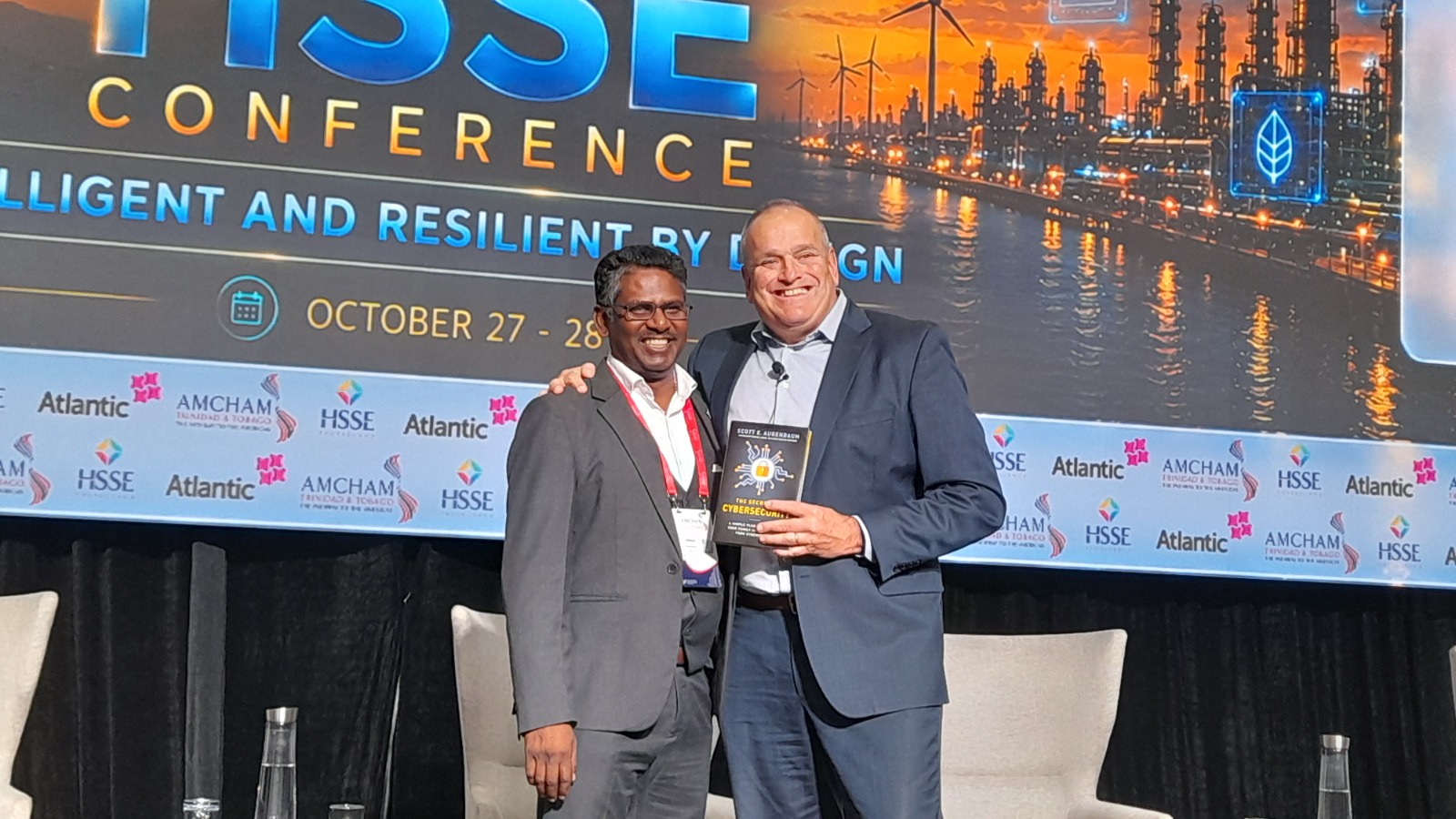
Caption: HSSE Manager for PROMAN Energy Balchan Jadoonanan receives a book authored by retired FBI Special Agent Scott Audenbaum. AZP News/Sue-Ann Wayow
- No one is immune: Retired FBI Supervisory Special Agent Scott Augenbaum warned the 30th Annual AMCHAM T&T HSSE Conference that cyber criminals target businesses and individuals of all sizes.
- A ‘people problem’: Almost 85% of financial losses stem from cyber-enabled fraud—manipulating people into making mistakes rather than high-tech hacking.
- Simple prevention: Most cyber crimes are preventable by pausing under pressure, double-checking requests, and picking up the phone to independently verify changes to banking or sensitive information.
- Top threats: Investment fraud and business email compromise top the list of cyber threats, with Artificial Intelligence (AI) making scams increasingly believable.
By Sue-Ann Wayow
That was just one of the advisories given to participants at the 30th Annual American Chamber of Commerce of Trinidad and Tobago (AMCHAM T&T) Health, Safety, Security and Environment (HSSE) Conference by the final speaker of the two-day event, retired FBI Supervisory Special Agent Scott Augenbaum, as he outlined four truths about cybersecurity.
Speaking on Wednesday at the Hyatt Regency, he said, “The first truth is that none of the victims ever expected to be a victim… ‘I don’t have anything that anybody wants.’ I would hear that with small businesses, I would hear that with non-profit organisations.”

Augenbaum said, “I am here to tell you the cyber criminals do not care who you are, they do not care about the size of your organisation. They want to target you to steal your data, they want to target you for ransomware, they want to target your parents…”
He noted that vulnerability spans all age groups, which is especially concerning as almost every 12-year-old child in the US now has a smartphone.
The other three truths, he revealed, are that criminals are rarely caught or prosecuted, getting stolen money back is nearly impossible, and most of these crimes could have been prevented.
Augenbaum brought the curtains down on the conference—which brought together major players in the energy industry alongside companies focusing on health, education, and security—with his presentation entitled, “Before the Fall – Developing a Cybersecure Mindset in the Age of AI.” He focused on how cybersecurity relates to fraud and how companies and individuals can prevent major financial losses simply by double-checking information.
Other speakers in that session included Manager of the Implementation Division of the Trinidad and Tobago Bureau of Standards, Gerard Maxwell; Senior Trade Specialist at the Ministry of Trade, Investment and Tourism, Aurelia Bruce; Advisor, Security and Corporate Services at the Trinidad and Tobago Unit Trust Corporation, Darrin Carmichael; and moderator Gervon Abraham, Head of Corporate and Regulatory Affairs (CORA) Caribbean at The West Indian Tobacco Company Limited (WITCO).
According to Augenbaum, companies’ data is breached almost daily, often by overseas hackers.
Also the author of the book The Secret to Cybersecurity: A Simple Plan to Protect Your Family and Business from Cybercrime, Augenbaum centred his presentation on understanding how hackers manipulate individuals into doing what they want—which most times involves sharing sensitive information or transferring money.
He recalled that just this month, one fraudulent transfer resulted in US$14.7 million being stolen in relation to the construction of the Regions Arena in the city of Mobile, Alabama. The transaction occurred in early October, but city officials were only informed on October 16. The FBI is now investigating, and the city has hired a law firm and a forensic accounting firm as part of its own internal review.
Explaining how easily this happens, Augenbaum said, “What happens is that the cyber criminal located somewhere in the world is able to gain access to the email account, read all the emails and, at the right moment in time, they are able to send an email over to the city and say, ‘Hey, we just want to let you know, we changed bank account information.’”
The person on the receiving end should have simply picked up the phone to verify the information received, he suggested.
Augenbaum asked the audience, “What about your organisation, what about where you are, are they going to pick up the phone?”
He noted that in the US, “Time and time again, people do what they are told to do in the email.”
“These are the types of things we are seeing every day,” Augenbaum said, noting that people keep asking what they can do technologically to protect their information and assets.
He said, “That is the problem. We all keep looking for technology solutions for what I consider to be a people problem.”
According to Augenbaum, prevention lies in five simple steps: recognising pressure, pausing before acting, verifying information independently, asking questions, and escalating early.
Almost 85 per cent of money lost is through cyber-enabled fraud, which he described as “tricking somebody into doing something they normally would not do,” adding that it remains heavily under-reported.
The major types of fraud, in order from highest to lowest, are: investment fraud, business email compromise, tech support fraud, confidence/romance fraud, and government impersonation.
Augenbaum said, “What is the number one impacting individuals? Investment fraud. And it’s things that we are seeing here in the United States; unfortunately, it would be things that you are going to see here in Trinidad and Tobago. These are the same things.”
He pointed out that extensive resources usually go into trying to solve the problem after it has occurred, even though basic actions could prevent it beforehand. Cyber crimes have been worsening annually, with a 100 per cent spike between 2020 and 2021 as a result of the Covid-19 pandemic, even as money spent on cybersecurity keeps climbing.
The good news, he noted, is that cyber criminals are not hacking directly into cloud servers.
“They are hacking into the cloud owner accounts,” he said.
Augenbaum warned that criminals study individuals, roles, and relationships, playing on emotions to get people to react quickly—which is all they really need.
“They want to make that reaction window as quick as possible, because think about it: when our emotions are up, our decision-making ability goes down, and that’s when they have an open door and that’s when there is financial loss,” he said.
He added, “Artificial Intelligence is making it so much more believable.”
Augenbaum spoke during the final session of the conference, entitled, “When trust breaks down: fraud, business continuity and organisational resilience.”