
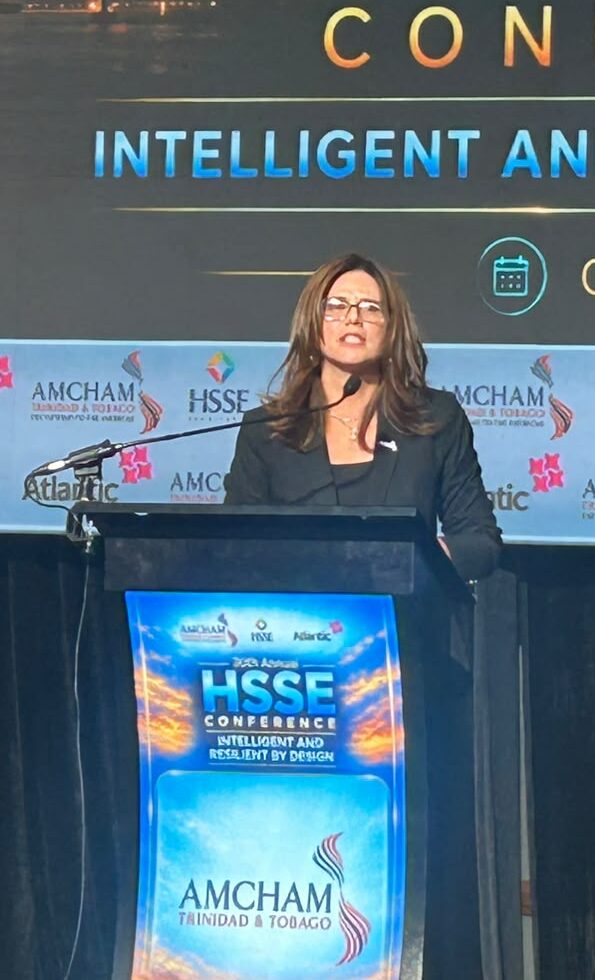
Caption: AMCHAM TT President Anna Henderson. AZP News/Anna Henderson
In Brief
- Burnout as a Safety Risk: AMCHAM T&T president Anna Henderson warned that employee exhaustion directly threatens workplace safety, decision-making and national productivity.
- Productivity Pushback: Addressing the national debate on productivity, she argued that growth cannot be achieved by forcing the same staff to work faster with fewer resources.
- Investment & Confidence: Speaking at the 30th Annual HSSE Conference, Henderson said T&T must embed world-class safety, environmental and governance practices into daily operations to inspire investor confidence and diversify the economy.
By Alicia Chamely
Employee burnout is no longer just a personal wellness concern, but a critical workplace safety hazard that threatens both business continuity and national productivity, American Chamber of Commerce of Trinidad and Tobago (AMCHAM T&T) president Anna Henderson warned on Tuesday.
Delivering the opening address at AMCHAM T&T’s 30th Annual Health, Safety, Security and Environment (HSSE) Conference and Exhibition, Henderson challenged corporate and state leaders to rethink what they expect from an already stretched workforce.
Henderson told delegates, “We often talk about resilience as though it means being able to take on more, work longer, adapt faster, and keep going no matter what is happening around us.”

She said, “But there is a point at which asking people to simply ‘be more resilient’ misses the real issue. People are tired.”
Employees are carrying heavy personal burdens into the workplace, she said, including financial pressures, family responsibilities and anxiety over national crime.
As the boundary between work and personal life blurs, exhaustion has become a direct operational risk, Henderson noted.
She said, “An exhausted employee may be less likely to speak up about a hazard.”
Henderson said, “A leader operating under constant pressure may miss something that they would normally catch. A team that has been stretched for too long may stop asking questions because everyone is simply trying to get through the day.”
The productivity debate
She linked the issue of staff exhaustion directly to Trinidad and Tobago’s ongoing national conversation on economic competitiveness and labour productivity.
While acknowledging that businesses and state agencies need to improve performance, she cautioned against chasing productivity gains on the backs of overworked staff.
“Productivity cannot simply mean asking the same people to do more work, faster, with fewer resources and greater pressure,” she said.
Henderson added, “If we want sustainable productivity, we have to pay attention to the conditions in which people work.”
She said that businesses must stop treating resilience as a worker’s ability to “absorb unlimited pressure,” and instead build environments where employees feel supported and safe enough to report hazards or near-misses without fear.
Hendersaon said, “A strong safety culture is not created by a policy sitting in a binder.”
She said, “A culture of safety cannot exist where people are afraid to tell the truth.”
Crime, heat and cyber threats
Marking the conference’s 30th anniversary under the theme “Intelligent and Resilient by Design,” Henderson urged executives to stop managing safety, security, technology and human resources in silos, warning that modern threats outside the workplace gates quickly spill inside.
Addressing the impact of violent crime, she said businesses cannot solve the country’s security crisis alone, but have a duty to protect employees who work late, handle cash or travel between sites.
“Crime does not stop at the workplace gate,” she said.
Henderson added, “It affects how people travel to and from work. It affects how employees feel about their safety.”
She noted similar real-world pressures from climate change and digital vulnerabilities. With the Trinidad and Tobago Meteorological Service warning of above-average temperatures and hot spells this month, she stressed that rising heat is not an “abstract climate issue” for construction, plant and outdoor workers, calling on companies to empower managers to adjust operations to protect staff.
On the digital front, she referenced recent warnings from Trinidad and Tobago’s Cyber Security Incident Response Team (TT-CSIRT) regarding active system exploitation, stressing that cybersecurity “cannot simply be left to the IT department” when operational staff are the ones left to manage a shutdown.
The two-day conference features international burnout and workplace resilience expert Paula Davis, along with cybersecurity and enterprise risk specialist Niel Harper.

Winning Investor Confidence
Looking ahead to Trinidad and Tobago’s broader economic goals, Henderson stressed that embedding strong HSSE standards from the ground up is essential if the country hopes to attract foreign investment, grow new industries and diversify the economy while strengthening traditional energy sectors.
“World-class HSSE cannot simply be something we talk about when an investor asks about our standards. It has to be part of how we do business,” she said. “A country that can demonstrate strong safety systems, responsible environmental practices, effective governance, and resilient organisations is a country that inspires confidence.”
Reflecting on the evolution of the conference over the past three decades, Henderson urged leaders to move beyond box-ticking exercises to meet the changing nature of modern risk.
She said, “The question is no longer simply whether we have a safety policy. It is whether that policy is reflected in the way we actually work.”
Henderson said, “And it is not simply whether we have resilient employees. It is whether we are building organisations that do not continually push those employees to their limits.”
See Winners: 16th Annual National Excellence in HSE Awards
Safety on Trial: Om Lalla on Why Paper Policies Fail in the Courtroom
When Systems Fail: Niel Harper Warns Cyber Threats are now Physical Safety Risks