
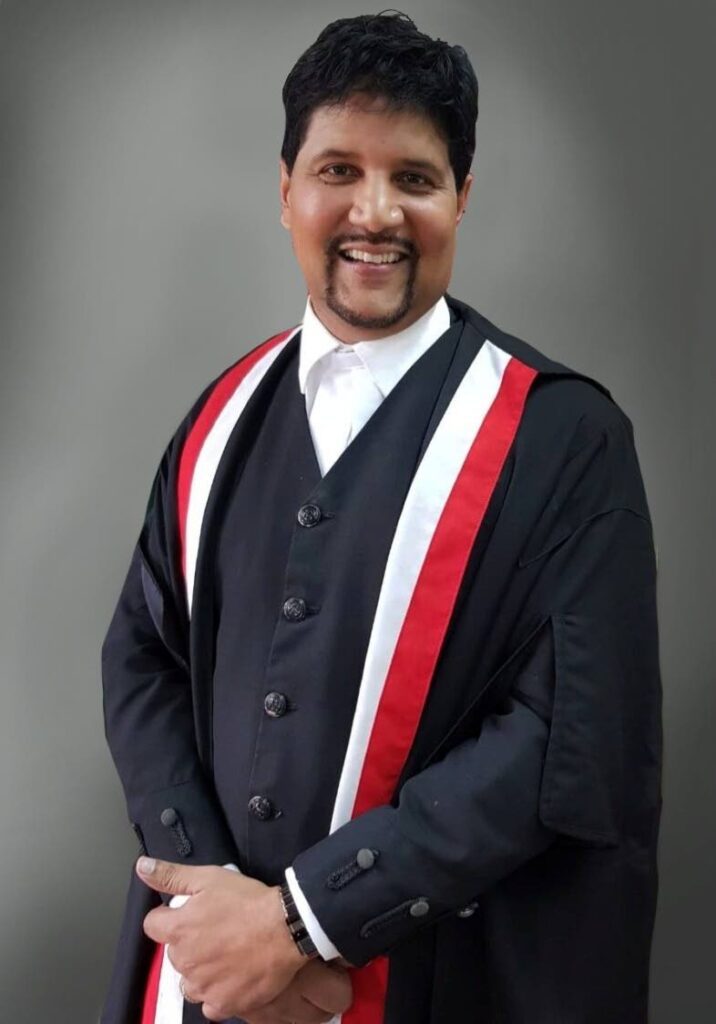
Caption: Justice Frank Seepersad
In Brief
- Mental health in focus: Justice Frank Seepersad says workplace safety must evolve beyond visible physical hazards to address bullying, excessive workloads, and toxic cultures.
- The legal framework: The judge noted that while the OSH Act already provides a foundation for risk assessment, T&T should look at how to address psychological harm with greater legal clarity.
- Safety is not ‘comfort’: He cautioned that psychological safety does not exempt employees from accountability, performance standards, or fair criticism.
- Proactive leadership: Employers do not need to wait for new laws; they should immediately train managers in emotional intelligence and monitor warning signs like high staff turnover and absenteeism.
By Alicia Chamely
High Court Judge Justice Frank Seepersad is calling for a modernised approach to occupational health and safety in Trinidad and Tobago, warning that a workplace can be physically secure while remaining “psychologically unsafe.”
Delivering an address titled “Psychological Safety: The New Frontier of Workplace Safety” at AMCHAM T&T’s 30th Annual HSSE Conference and Exhibition at the Hyatt Regency on Tuesday, Justice Seepersad urged employers and lawmakers to look beyond traditional, visible hazards such as unguarded machinery, exposed wires, and unsafe scaffolding.
Justice Seepersad said, “Some of the most consequential hazards of the modern workplace leave no debris on the factory floor.”
He said, “Rather, they may arise from excessive workloads, bullying, humiliation, and cultures in which employees conclude that silence is safer than speech.”

The legal foundation
Raising the question of whether local legislation adequately reflects modern realities, Justice Seepersad said that the conceptual foundation for preventing psychological harm already exists within the Occupational Safety and Health (OSH) Act.
He noted that Section 6(1) of the Act mandates employers, so far as is reasonably practicable, to ensure the safety, health, and welfare of employees, while Section 13A requires risk assessments.

Justice said, “The preventative philosophy of occupational safety provides a useful analogy: the law does not ordinarily wait for a defective machine to injure a worker before recognising the importance of a guard.”
He said, “If, therefore, we accept the principle of prevention when protecting the body, why should the conversation about foreseeable workplace risk end merely because the potential injury may be to the mind?”
Pointing to international frameworks in Australia and the United Kingdom—which actively assess psychosocial hazards and work-related stress—the judge noted that while foreign laws cannot simply be transplanted, they prove that invisible psychological risks can be identified, assessed, and managed. He suggested that T&T must now consider how to develop its existing statutory foundation to address these realities with greater clarity.

Safety vs comfort
However, Justice Seepersad drew a line between psychological safety and “psychological comfort,” cautioning that a healthy workplace does not mean an environment free of pressure or accountability.
He said, “Workplaces require standards, performance assessments, correction, and, sometimes, difficult conversations and consequences for misconduct.”
Justice Seepersad said, “Criticism is not necessarily bullying; disagreement is not necessarily harassment; and an adverse managerial decision is not, without more, an assault upon well-being.”
He said that workplace responsibility is reciprocal, noting that while employers must answer for the environment they create, employees remain accountable for their performance, conduct, and treatment of others.
A call for empathetic leadership
Rather than waiting for legislative reform, Justice Seepersad urged organisations to take immediate steps to audit and improve their internal cultures.
He advised management to pay close attention to workplace patterns—such as persistent absenteeism, high staff turnover, recurring grievances, and excessive hours—warning that these metrics often reveal deeper issues that isolated statistics conceal.
Furthermore, he called for a shift in leadership style, stating that empathy, emotional intelligence, and conflict-resolution training are core managerial skills rather than “optional courtesies.”
“What management intends as correction may be received as humiliation; what is meant to motivate may instead alienate,” Justice Seepersad noted, adding that a healthy workplace culture makes room for “candour without cruelty, authority without arrogance, and accountability without fear.”
The judge said, “The true test of leadership is not merely whether instructions are followed, but whether dignity and confidence survive the conversation,” he concluded.
He said, “Ultimately, the safest workplace is not simply the one in which no one gets hurt; it is the one in which people can work, speak, contribute, and be held accountable without surrendering their dignity.”
See related stories below:
‘People are Tired’: AMCHAM President Calls for Rethink on Safety, Burnout, Productivity
See Winners: 16th Annual National Excellence in HSE Awards
Safety on Trial: Om Lalla on Why Paper Policies Fail in the Courtroom
When Systems Fail: Niel Harper Warns Cyber Threats are now Physical Safety Risks